Triggering Nuclear War: Hazards of Husbanding Wargames

by

Vice Admiral (retired) Vijay Shankar

Busting the canard that, between India and Pakistan the nuclear overhang is so fragile that a terrorist provocation by Pakistan cannot be met by a conventional response, for fear of triggering a nuclear exchange.

Wargaming

The roots of wargaming trace back to ancient India and China. The former refined the art to the classic board game of Chaturanga which in time evolved to the modern game of Chess, where a campaign was waged between two opponents through manoeuvres by the two arrays alternately; each piece had intrinsic abilities limited in their facility to engage the adversary. Much like the dynamics that drive a nation state whose comprehensive power is the aggregate of its individual strengths as defined by indices that take into account military, political, economic, cultural and leadership factors. So the game was played between two equivalent forces pitted against each other. The skills of a player was determined by his dexterity to manoeuvre, thrust, balance and out-think his adversary through deception and by attaining a stronger strategic posture within the rules of the game. Loss of the king led to what, in geopolitical terms, is referred to as the end of a regime.  

Both China and India also gave to the world the classic texts “The Arthashastra” by Chanakya and “The Art of War” by Sun Tzu emphasizing the importance of strategic thought as a critical feature of statecraft. The two texts form a compilation of aphorisms and principles that outlined the framework for wielding power and, indeed, waging armed conflict. They also prescribed the determinants of good national politics and defined the groundwork for use of modelling and wargaming as a training and decision-making tool. As history progressed, various cultures, including the Greeks and Romans, developed their own wargames, demonstrating their utility in honing military strategy.

The 19th century marked a significant transformation in the field of wargaming, particularly with the Prussian Army. Theorists such as Carl von Clausewitz translated their experience in the field to formalizing the concept, recognizing that military decision-making could benefit from structured simulations of battle scenarios. This in turn led to the development of Kriegsspiel, a table top wargame that allowed officers to practice operational and tactical decision-making.

The essence of the wargame is in discerning the thought processes of a Planner in arriving at a strategic, operational or even tactical decision; and analyse how best to arrive at an optimal outcome that could serve the purpose of enriching the art of state craft, developing war fighting doctrines or even honing skills of a tactical Commander. The intention was not to steer the wargame in a direction that served to fulfil or satisfy a preconceived argument.

The South Asian Stability Wargame

In March 2013, the Centre on Contemporary Conflict at the US Naval Postgraduate School conducted a strategic wargame, euphemistically called the ‘South Asian Stability Workshop’. The event was scheduled in Colombo Sri Lanka.  

The Wargame was politico-military in nature; its stated objective was to “examine crisis escalation dynamics in South Asia”. It involved the creation of a setting that was steered through events and three sequential response moves for which the country teams developed political and military directives. The directives for each move were analysed and adjudicated by Control setting-up specific situations for the next move. The third move was to lead to a possible decision to use nuclear weapons. Events were triggered by a planned Pakistan sponsored terrorist attack in a crowded sports stadium in India that resulted in the indiscriminate killing of a very large number of spectators including several VIPs. The entire process that shaped and drove the wargame was controlled within the rigid parameters of the following structure:

  • A scenario design that put in place the geographical setting, forces involved and the objectives of each side. This left little planning elbow room.
  • Country teams were assigned, however the participants neither had exhaustive domain expertise nor the behavioural bent of extant leadership. 
  • Game mechanics which included rules, parameters, and decision-making processes were established to govern how players could interact with the scenario.
  • Gameplay followed a rather inflexible path of decision making, issue of orders to forces, and engagement in strategic and operational discussions. The game in effect yo-yoed from the tactical to the Strategic levels with unreal rapidity.
  • The use of conventional forces in response to the terrorist provocation at once saw the deployment of tactical nuclear weapons by Pakistan in the tactical battle area where Indian Independent Combat Groups (ICG) launched rapid retributive thrusts to strike at terror infra-structure and their supporters.    
  • Analysis: Observers or analysts monitored the game, collecting data on the decisions made, outcomes, and the impact of those decisions on the scenario with only one purpose; to initiate a nuclear exchange.

As the game proceeded, the intention of Control became more than apparent; it was to compress the existing nuclear overhang to an extent where it provided the space for acts of State sponsored terror but none for a conventional kinetic response. The Game turned out to be a not so convincing argument for the tendentious notion that, between nuclear armed nations, there was no space for retaliatory action by conventional forces to terror attacks planned, armed, trained and sponsored by one of the States that had adopted the use of terror as an instrument of foreign policy.  

Launch of a Nuclear Canard that Persuaded a Strategy of Restraint

After the withdrawal of Soviet forces from Afghanistan in 1989, there was a surge in tensions along the Indo-Pak Line of Control in Kashmir which constituted, as interpreted by US ‘experts’, an imminent nuclear flash point. Two contributory factors provoked this ‘narrative’ said the American interlocutors; firstly, the antagonists involved were undeclared nuclear armed states and secondly, events of 1989 that led to the withdrawal of Russia from Afghanistan had released the victorious Mujahidin for deployment elsewhere and in Kashmir; it also set in motion a hubris in the Pakistan ‘deep-state’ that translated to a brutal insurgency in the Indian state of Kashmir. The latter resulted in genocide and mass exodus of Kashmiri Pandits out of the State leading to the shoring-up of Indian security forces in the State. To substantiate the American narrative a dubious report was released by the US State Department’s Bureau of Intelligence and Research titled “India-Pakistan Relations: A Delicate Balance” that suggested (rather contrarily) that in the unlikely event of  “hostilities, India may escalate the conventional war by triggering events to take out all of Pakistan’s nuclear weapons (ironically, as recent as end 1989, the Bush Sr administration had signed off the fact that Pakistan did not possess nuclear weapons) facilities in coordinated surgical strikes.” This document was further addled in May of 1990, when the then Deputy NSA Robert Gates, came scurrying to the sub-continent on a covert Quixotic mission to defuse a mythical nuclear war.     

And thus began a long saga of misinformation and half-truths that emphasised the canard that between India and Pakistan the nuclear overhang was so fragile that a terrorist provocation by Pakistan must not bring about a conventional response by India for fear of triggering a nuclear exchange. Unfortunately, from the 1993 Mumbai bombings, hi-jacking of IC 184 in 1999, through the Kargil ‘invasion; to the assault on the Indian Parliament in 2001, the 2008 three day carnage in the financial capital of Mumbai and a host of other terrorist onslaughts by Pakistan based terror outfits (Jaish-e-Mohammed, Lashkar-e-Taiba, Hizbul Mujahedin) the self-shackling mantra of denying conventional response to terrorist attacks took root in India as the inane ‘Strategy-of-Restraint’ which contributed in large measure to paralysis of military policy when confronted with incidents of cross border terror attacks.

To Bleed India by Inflicting a Thousand Cuts: Instrumentation of Terror Groups

Carl von Clausewitz’s unerringly wise counsel ought to have fallen on Indian ears, that even the “simplest” strategic decision making can be bewilderingly difficult. And so it must be with Pakistan’s threat of nuclear weapons usage in protraction of a terrorist attack sponsored by them in the first instance; despite there being no precedence of such action, nor incentive of benefit or even inclination to escalate to a nuclear exchange. The Pakistan Establishment’s doctrine has remained committed to two cardinal dogmas, firstly the instrumentalisation of Islam using jihadi proxies as tools of a policy (Fair Christine, Fighting to the End, Pg. 80-89) to “bleed India by inflicting a thousand cuts”; and secondly, to support the discredited ideology of the “Two Nation” theory in order to sustain popular appetite for unending conflict with India. In this frame of reference, the question of intensifying the conflict to the level when nuclear self-destruction is assured appears aberrant.

The link between sub-conventional warfare and nuclear war fighting is at best a tenuous one. Conceptually, no amount of tinkering or reconstitution of nuclear policy can deter a conventional response to terror attacks. Such a notion would appear far-fetched because of the very nature of the weapon involved. Pakistan has in its arsenal tactical nuclear weapons (TNWs) with the stated purpose of countering an Indian conventional strike. Almost as if to suggest that they control the levers of nuclear escalation. This is an odd proposition since India does not differentiate between tactical and strategic nuclear weapons, (the bed rock of its “No First Use” policy).   

In the end analysis, the use of nuclear weapons introduces a new and uncontrollable dimension. Logically, if a Pakistan sponsored terror attack is the triggering event of a sequence of reactions, then it must equally be clear that their nuclear red lines give space for a conventional response. After all, the premise that a terror attack is seamlessly backed by nuclear weapons is not only ludicrous but is not even the Pakistan case. For, when dealing with the threat of use of nuclear weapons, to suggest that ambiguity and First Use provide options, is to suggest that nuclear war fighting, almost in conventional terms, is an option. This is denial of the nature of nuclear weapons and statements that have emanated from Pakistan’s leadership support the idea that only a threat that jeopardises the very existence of that State can provoke the First Use of nuclear weapons, by which is implied;

  • Loss of vast territories
  • Substantial destruction of the military
  • Economic strangulation
  • Destabilising of the nation can provoke the first use of nuclear weapons.

Against the reality of conventional war with its limited goals, moderated ends and the unlikelihood of it being outlawed in the foreseeable future, the separation of the conventional from the nuclear is a logical severance. Nuclear weapons are to deter and not for use; intent is the key; transparency and an abhorrence of ambiguity are the basis of its credibility. These remain the foundational principles that a nuclear weapon state must adhere to. Given the politics of the region, historical animosities and the influence of jihadi principles on the military in Pakistan, the dangers of adding military perfidy is more than just a possibility; however, to link nuclear malfeasance appears fanciful.

And yet the bizarre hypothesis still persists that relations between the two nuclear armed neighbours are plagued by a nuclear nightmare; of Pakistan in possession of a hair-trigger, opaque, nuclear arsenal that has embraced tactical use under decentralised military control, steered by a doctrine seeped in ambiguity and guided by a military strategy that carouses and finds unity with jihadists, not forgetting that the effect of an enfeebled civilian leadership in Pakistan that is incapable of action to remove the military finger from the nuclear trigger only adds to this premise. But, it does not take a great deal of intellectual exertion to declare that this nightmare in the wake of Operation Sindoor stands busted.

The catch is, as Cohen so succinctly put it (The idea of Pakistan, Cohen Stephen, Pgs. 97-130) “Pakistan will continue to be a state in possession of a uniformed bureaucracy even when civilian governments are perched on the seat of power. Regardless of what may be desirable, the army will continue to set the limits on what is possible in Pakistan.” At the core of this outlook is the rather obsessive “utilisation of Islamist militant groups as tools of foreign policy” (Fighting to the end, Fair, Christine Pg. 85) and the fatal contradiction of neutralising some inconvenient jihadi groups while instrumentalising others to further their revisionist policies.

Operation Sindoor; Larger Impact of the 88 Hour War

From a long term war fighting perspective ‘Operation Sindoor’ signals a strategic metamorphosis in the nature and manner in which a nation’s military must reform in order to fight and win a modern conflict that is limited both in time and objectives.

On 22 April 2025, Pakistan sponsored terrorists killed, in a most barbaric manner, 26 tourists in the idyllic meadows of Baisaran near the hill station of Pahalgam in the Indian Union Territory of Jammu and Kashmir. What was singularly heinous about the massacre was the identification by religion of the victims and selection of men only shot at point blank range in front of wives, women and children with instructions to carry their message of religious odium to the rest of India. This assault was not a random incident of terrorist violence but carried with it a diabolical urge to arouse large scale sectarian passions within the country. The Resistance Front (TRF) was quick to claim responsibility for the carnage. The Front is an offshoot of the UN proscribed terror organisation, Lashker-e-Taiyba. It claimed control and responsibility not once on 22April but again the very next day. However, TRF denial on 26 April came after the Pakistani security establishment pressured the LeT-linked terrorist group to distance itself from the mass slaughter; for the purpose of the terror attack had failed on three counts. Firstly, the objective of undermining normalcy returning to Jammu & Kashmir, particularly, to impact the mainstay of the economy, tourism (a record 23 million tourists visiting the valley in 2024) had come a cropper as the flow of vacationers was quickly restored. Secondly, anticipated sectarian passions were never aroused as massive protests by Kashmiris erupted across the Valley against the attack. And lastly, the international community’s widespread and unconditional condemnation of the attack along with expressions of sympathy towards the victims. The immediate Indian reaction to the massacre came on 23 April with the Indus Water Treaty (IWT) being held in abeyance followed by a promise of a kinetic response at a time and place of choice.  

Operation Sindoor was more than a swift and precise military response to another cross-border terrorist attack. It marked a strategic inflection point. In just 88 hours, India used indigenous systems to strike hardened targets across the border with precision, speed, and overwhelming effect. No US systems. No foreign supply lines. Just BrahMos missiles, Akashteer air defence units, Rudram anti-radiation missiles, the Netra Airborne Early Warning & Control System (AEW&CS) and loitering munitions designed or assembled at home. The Operation was conducted in three distinct phases.

  • Phase I (Night 06/07 May), Operation Sindoor launched in retaliation for the Pahalgam massacre; targeted nine terrorist centres from Bahwalpur in the south, Muridke and Sialkot in the Lahore sector and Muzaffarabad along with 4 other sites in POK.
  • Phase II (08-09 May), Pakistan military response to the Indian attacks on terror sites with missiles, drones and UAVs, as it took ownership of the terror infrastructure.
  • Phase III (10 May), Indian suppression and counter-air operations aimed at destruction of select Pakistan air defence networks followed by crippling attacks on strategic Pak air assets, infrastructure and Command & Control networks. Pak DGMO calls for a ceasefire. India agrees for cessation of fire.

During Phase I, India targeted nine terrorist strongholds. Five in Pak occupied Jammu and Kashmir which included Sawai Nala camp in Muzaffarabad- a training centre for Lashkar-e-Taiba. Syedna Bilal Camp in Muzaffarabad- This was a staging area of Jaish-e-Mohammed. Gulpur camp in Kotli – This was a base camp of LeT that was active in Rajouri and Poonch areas of Jammu. Barnala camp in Bhimber.  And Abbas camps in Kotli- Fidayeen of the LeT were prepared here. Targets within Pakistan included Sarjal Camp and Mehmoona Joya camp, both in Sialkot. Markaz Taiba Centre in Muridke – Terrorists who participated in the 2008 Mumbai terror attacks were trained here. Markaz Subhanallah in Bahawalpur; the HQ of Jaish-e-Muhammad (JeM) where recruitment, training, and indoctrination of terrorists targeting India was undertaken. Significantly the last two were major centres of terror activities and housed the headquarters of the LeT and the JeM. Battle damage Assessment revealed that all these targets were hit with uncanny accuracy and minimal collateral damage. Phase II and III emphasised, with telling impact, the inviolability of Indian air defences and the effectiveness of Indian counter air and offensive air operations.

Neutral analysts have determined that India’s Operation Sindoor was a decisive triumph for India, because Pakistan could neither penetrate Indian air defences nor could they cause any disruption to the offensive action taken by the Indian military. Indian airspace was free of any Pakistan aggressive action, while Indian counter air operations had rendered Pakistan open to bombardment by Brahmos, UAVs, hovering munitions and other missiles.

Eleven Pak air bases had been struck to the extent of annulling their operational capabilities. Also, five air-defence systems of Chinese origin had been destroyed opening vast gaps in their air defence environment. While at least two of their AWACS had been destroyed along with several fighter aircrafts either in the air or on ground; the strikes were accompanied by large scale spoofing and deception manoeuvres. More importantly their command centres including the vital one at the Nur Khan air base that houses its nuclear command facilities along with strategic mobility control and communication networks was rendered dysfunctional.

Meanwhile, Pakistani air-defences—built largely around older Chinese systems like the LY-80, HQ-9/P, and FM-90—were powerless to detect, deter, or respond to the strikes. In the skies over Pakistan, India didn’t just dominate, but its counter-air operations redefined and placed awkward questions for regional deterrence.  

Perspectives for Arm-Chair Strategists

The ‘88-hour’ engagement came as a breath of fresh air to strategists long entrenched in the belief that limited armed engagements could only be decided by the occupation of territories, weight of destruction and casualties rather than the impact of demoralisation, exposing vulnerabilities of defences and out manoeuvring of the adversary. In a reverse analogy, just as the machine gun and trench warfare provided the negative and bizarre logic for the clash of mass against mass resulting in a meat-grinder military doctrine; swift and complete counter air operations followed by targeted offensive air operations are the key to success in limited modern operations. Remember in Operation Sindoor counter air and offensive air operations followed in rapid succession of minutes rather than hours which had a paralysing and unbalancing effect on the adversarythat quickly resulted in the first calls for a ceasefire.

For the arm-chair strategist, some of who bewailed the fact that, cessation of operations came at a time when the Pakistan air space was wide open to an extent when a joint air-land thrust ought to have expanded their objectives to the occupation of territory and salients in POK. This is symptomatic of a lack of understanding of the nature of modern power, its application and its deterrent impact; that is, to prevent certain threats from materializing by posing an even greater threat. There is no inevitable symmetry between offensive and defensive power as both are influenced as much by resolve as by magnitude of power and immeasurable considerations such as surprise, geography, limitations on purpose and indeed the degree to which objectives are pursued. These characteristics of power will also determine the risks that the state is willing to take. Perils are heightened as offensive power gains the edge over the defense and penetrates to an extent when friction clutches-in. In operation Sindoor, objectives were limited, risks of getting embroiled in a drawn out slugging match of attrition particularly on land was to be avoided, remember the higher political directive “Samay seemit hai aur laksh bade (Time is limited and our aims are large) almost as if to suggest that the engagement must be brought quickly to a decisive conclusion without jeopardizing our long term developmental agenda. Assessment of risks had to account for possible escalation and how far the adversary’s nuclear bluff could be called. Importantly, deterrence provided incentive for innovation, both political and operational to India that ran consistent with rapidly changing technology, as long as it was brisk in time and limited in space. The key consideration was that Sindoor was retaliation to an act of terror; so-much-so that had Pakistan chosen not to respond militarily, the operation would have concluded after Phase I.  

As for the “narrative-war” which some severe critics of Operation Sindoor believe ‘India lost the plot’; is there really any such thing that has a lasting impact in this age of transparency? In the American lexicon ‘narrative’ implies “a story or account of events, or the like, whether true or fictitious”. Surely the final arbiter was the stark photo evidence of the demolition of the JeM headquarters in Bahwalpur, devastation of the LeT headquarters at Muridke and other terror camps and critically the suppression of the Pakistan air-defences and the neutralisation of their strategic air stations including the Nur Khan air base. After all it was the Pakistan Director General of Military Operations that sued for a cease-fire.     

Legacy of Op Sindoor

A flawed strategic anti-terrorist doctrine will lead to not just advancing enticement for similar acts of terrorism but also absorb great energies and resources of the State in attempting to reconcile the act with advocacy of restraint; besides projecting an underlying softness of the State. In the absence of a doctrine, the case reduces to responding by determining the absolute rights and wrongs as determined without considering that the very sovereignty of the nation (by which is implied the ultimate authority of the State for the maintenance of order) is on trial. This makes for a recipe of inaction; unfortunately it was, to a great measure, the ill-conceived policy followed by India in the past.    

Perhaps the compelling legacy of Operation Sindoor is the new norm it has set for the Indian government, the use of force against terrorist-linked targets in Pakistan proper has now moved from “anomaly” to the “rule”. Whereas past crises of similar nature would elicit symbolic action, future attacks on Indian soil – especially those traced to organizations and infrastructure across the border, will invite a response of equal or greater intensity to target and degrade entities enabling terrorist action; which includes support and financing elements.      

Technology and Survivability of Nuclear Forces

There can be no absolute cure for war; yet in the absence of a total remedy for conventional war, there had to be hope to prevent catastrophe; from this developed the idea of deterrence, the instrument to enable deterrence was the nuclear weapon. And therefore the first and most vital condition from a nation’s security standpoint is to institute measures that provide a guarantee to the state (as well as the adversary) that a response to a nuclear attack will be a devastating retaliation in kind. As Churchill, in 1955, put it “…by a process of sublime irony, the world was facing a situation where safety will be the sturdy child of terror (balance of terror), and survival the twin brother of annihilation (MAD)”.  

The question then arises; will emerging technologies raise expectations to enable the employment of forces that will significantly reduce the survivability of an adversary’s nuclear forces in a conflict? If not, then is the perspective that Mutually Assured Destruction (MAD) remains a powerful reason for a deterrent relationship to hold valid? Also, if missiles today can perform all of the technical functions of the strategic nuclear bomber with greater speed and more precision, then are we witnessing the phasing-out of the manned air vector? But at the same time has adequate thought been given to the change in character and vulnerability of a nuclear second strike policy based entirely on the missile (ballistic or cruise) launched from mobile carriers and driven by Artificial Intelligence? Operation Sindoor, within a matter of hours had exposed the vulnerability of the Pakistan air-defences and their National Command Authority. Did this in turn expose their nuclear arsenal to counterforce action? Also, will not the reliability of a counterforce strategy decline with time, technology and transparency? These are complex questions for the political leadership for whom nuclear strategy may be but one of his concerns, excessive complexity may itself lead to paralysis as Clausewitz had noted.

Conclusion

We began with the propagation of an intricately fabricated canard that “between nuclear armed nations, there was no space for retaliatory action by conventional forces to terror attacks planned and sponsored by one of the States that had adopted the use of terror as an instrument of foreign policy.” Despite the fact of the disingenuousness of the sham; its plausibility lay in the proposition that linkage between Pakistan’s use of terror organizations as a tool of state policy to wage war on India has perverse consequences that link it to nuclear escalation. This bizarre correlation, Pakistan will have the world believe, comes to play if and when India chooses to respond with conventional forces to a terror strike puppeteered by their “Deep State.” Fatefully this policy has led to a self-destructive urge that has decomposed the diversity of Pakistan society. Not only are some terror clients at war against the state but some have led the persistent call to violence against Shias, Ahmedias, Barelvis, Agha Khanis, Borees, Baluchis and not forgetting Hindus and Christians. The Army has shown absolutely no predilection to eliminate these outfits; only because they serve their purpose in India and for fear that any act against their terror clients is acceptance that the ‘two-nation’ is misbegotten and indeed spurious. 

At the heart of the matter is Pakistan’s, or at least its army’s, rejection of any separation of the Maulvi from the state. There are two critical reasons for this; firstly Muslims are seen to constitute a separate nation despite the fact of the creation of Bangla-Desh and the Muslim demography of India almost equalling that of Pakistan.  Secondly, the army’s self-appointed role to defend the “two-nation” ideology. Six days before the carnage of Pahalgam, the Pakistan Army Chief, on 16 April 2025, ranted on this ludicrous theme at a public convention of overseas Pakistanis, notwithstanding the successive military defeats it has suffered at India’s hands or the political and diplomatic setbacks it has faced has convinced it to revise its defunct ideological dogma. Operation Sindoor is yet another case of having suffered crippling strikes to its terror infrastructure as well as its vital air assets and air defence networks in just 88 hours. Yet, defeat for Pakistan is only with the death of its ideology and this can only occur if the army wills it. No amount of economic hardships (the state has been to the IMF for a bail out on 25 occasions in its short existence) nor has the failure of its many dictatorships that ruled it for 34 of its 78 years of existence in any way prodded the army to surrender its power or even allow a political system to take root in that country. The improbable paradox is that Pakistan is a case of an army that depends on an interminable conflict with India, a failing economy, splintering society, rapacious politicians and geopolitics of international opportunism for its very existence.

So the question that begs to be asked is why the leading democracy in the West is so disinclined to bring about a revision in the politics of Pakistan. And why, indeed, has it so vigorously supported the nuclear canard even though terrorism is a common universal scourge? And does the US Government need to be reminded that during the twenty-year “War on terror” in Afghanistan the Pakistan state and its army played a treacherous and duplicitous role that milked the US administration of over $32 billion while all the time providing safe havens and logistics to the very groups that they were fighting the war against. And who can forget where Osama-bin-Laden had gone into hiding, before he was found and killed. The White House, historically, works with and through the Pakistani army to manipulate that state’s foreign policy; it served a strategic “Pentagon-led” purpose up to the break-up of the Soviet Union. Is there a reason why the US is unlikely to lose interest in the failing Pakistan and is that because of the rooted relationship that their deep states have nurtured and benefited from over the years? Or does the sustenance of the nuclear canard form a part of, a yet unseen, strategic scheme?
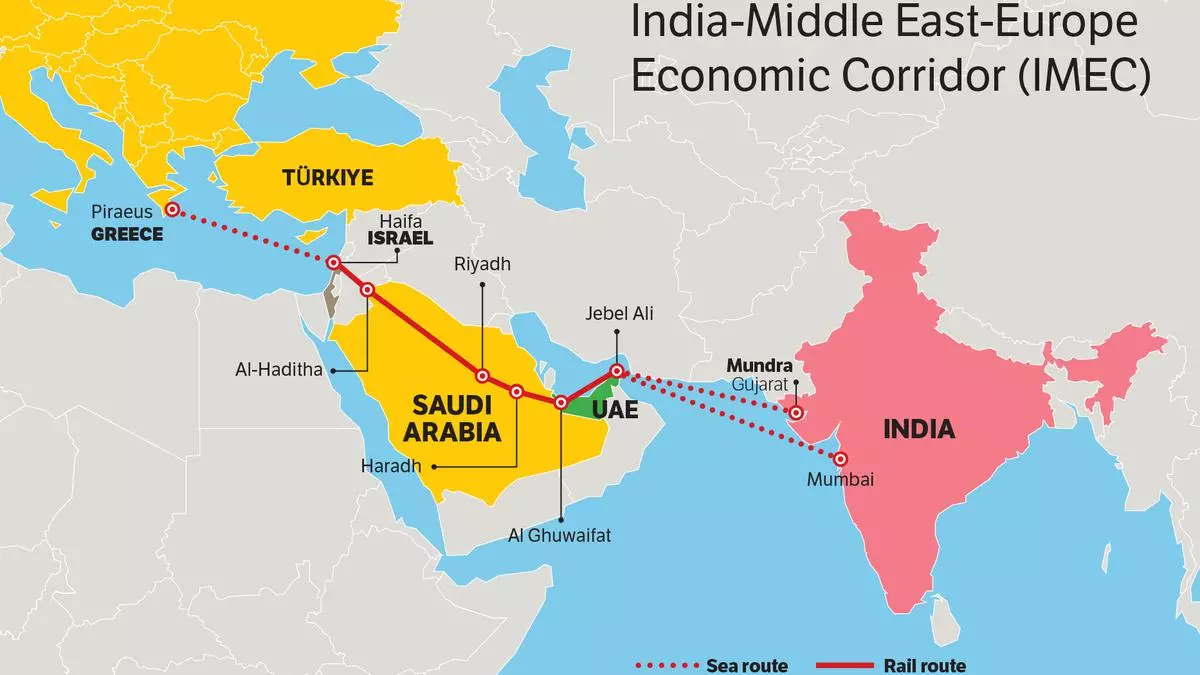
The India-Middle East-EU Economic Corridor (IMEC)

Pipe Dream or a Pathway to Shared Progress

By

Vice Admiral (Retd) Vijay Shankar (to be published)

Transcontinental Trade; from Shunya to Infinity

          At the heart of ancient Eurasia was India-a culture that exported its diverse civilisation, creating around it a vast intellectual domain. Vedic mathematics, technology, astronomy, art, religions, music, dance, literature and an irrefutable concept of the nature of creation and Man’s place in a dynamic universe; all put together pioneered a new outlook to the meaning of things. These revelations wove a path around the world through the medium of commerce and communications, which stretched across the Arabian Sea over land and sea to Greece and Rome in the west, to China in the north and to South East Asia in the east. The impact of India’s civilizational evolution stimulated innovation and growth. From the largest temple in the world at Angkor Vat to the Buddhism of China, from trade with Mesopotamia and Greece to the creation of the decimal system that we use today; particularly the sublime understanding of zero and infinity. India transformed the culture and technology of the ancient world (as reconfirmed by recent archaeological finds at Berenike) “…excavations make clear that it’s no longer possible to think of the trans-ocean trade as a ‘Roman’ endeavour. By the first century A.D. India was one of the main powers in these transcontinental trade routes.” -That was till a millennium ago.

Strategic Course of Geopolitics 

       Writing in 1890, Sir Halford Mackinder , suggested that the course of politics is the product of two sets of forces, “Impelling and Guiding. Impetus originates from a nation’s past, from historical stimuli embedded in a people’s character and tradition. The present, Guides politics by economic realities and geographical opportunities. Statesmen and diplomats succeed and fail pretty much as they recognise the irresistible power of these forces.” This discernment of geopolitics and the dynamics that influence it, is far more elegant than some of the more contemporary understandings led by Henry KissingerHans Morgenthau, Freidrich Ratzel and other advocates of Realpolitik. The latter suggested that geopolitics deals with power of a state and the will for domination; from this standpoint, lesser powers are condemned to the periphery. The governing doctrine was: national interests are best served through skilful manipulation by the State of the changing international balance of power. ‘National Interests’ in realpolitik is central and the art of the statesman is to strike equilibrium amongst competing interests through the instrument of power of the State.

          Clearly, while Mackinder saw the past as a force of stimulation; it was the critical reality of the present and its circumstances that became the prime mover of a nation’s role in geopolitics; Kissinger and his ilk saw “national interests” and the quest for balancing power as the motive force powering geopolitics. Absent was that it also became the catalyst of antagonism amongst nations. The latter perception, left the lesser powers to be mere ‘camp-followers’ with the corollary belief that geopolitics was about antagonistic ‘Blocs’ with irreconcilable differences seeking to dominate each other.

Genesis: IMEC the Multimodal Logistic, Energy & Digital Highway  

        An Intergovernmental Framework Memorandum of Understanding was signed on 10 September, 2023 during the ‘Group of 20 nations’ summit held in New Delhi for a multimodal infrastructural corridor that bound together nations with common equitable purpose. The Project was born of a need for a trusty corridor that did not owe its existence to the control of any one dominant Power. It is driven by three objectives: first, to provide strategic transportation arteries that connect to existing sovereign networks and in turn facilitate uninterruptible movement of global trade and commerce by land and sea. Second, to lay a grid and system of pipelines that facilitates free flow of energy (renewable, fossil and hydrogen). Third, to institute a digital-highway that links the participating nations to national webs for streaming of financial transactions, information and knowledge. What is unmistakable about the enterprise but remains undeclared is its underlying intent as an equitable, dependable and preferable option to China’s Belt and Road Initiative (BRI) and to provide an alternative to the Suez Canal.  The unique feature of the Corridor is the creation of a vast digital and energy highway in addition to arterial transportation freeways. The need and willingness to create an alternative to the extant and periodically troubled 195 Kilometre long Sea-Line of Communication running through the Suez Canal is a feature that harks back to the pre-First World War era.    

Lesson from History: The Ill Fated Baghdad Bahn  

        In 1903, a concession to construct a railroad was awarded by the Ottoman Sultan Abdul Hamid II (1876-1909) to Germany. The strategic Berlin-Baghdad Railroad was conceived, designed and financed by Germany to exploit Ottoman pan-Islamism in order to threaten logistic networks from British India and isolate their Colonial possessions. The rail line, planned to connect Berlin with the Ottoman cities of Konya and Baghdad with a new 1,600 kilometres track through modern-day Turkey, Syria and Iraq, from where the German vision to establish a port in the Persian Gulf bypassing the Suez Canal could be realised.                          

        The project was a manifestation of a dramatic growth of Kaiser’s economic clout. It played a role in the British-German trade rivalry, and in promoting hostility between the Entente and Central powers. Ironically the railway, on the one hand, helped unite the Entente powers against Germany; while on the other; led Germany into fear of encirclement and brought on World War I.  

        The scheme never fully fructified due British sponsored insurgencies in the vital Najd region of Saudi Arabia and technical glitches in the remote Taurus Mountains. Delays meant that by 1915 the railway was 480 kilometres short of completion, severely limiting its strategic utility during the war. The project failed on account of one critical consideration: the idea of strategic domination was not shared by the stake holders.            

        Is there a rude shock awaiting the IMEC? Is its timing so bedevilled that the enterprise may be consigned among the many lofty schemes that litter history, of well-meaning-but-star-crossed endeavours? Or can the project stand as a model for collaborative undertakings that disavow the impulse for domination?    

Uncertainties of the Times  

          A change has occurred. A world that was inclined towards global order driven by growth, interdependence and globalisation, has been replaced by a return of legacy tensions reminiscent of the “Cold War”, quest for military solutions, manipulation of governments into well-disposed pliable regimes; and, paradoxically, growing insularity amongst nations characterise the contemporary milieu.    

          Self-indulgent ‘National Interests’ are at crossroads; while Balance-of-Power advocates find themselves on a limb when faced with eschewal of individual sacrifice in favour of less disruptive sequestered alternatives. A reality well-arranged for over three decades through power and political manipulation is in the process of morphing into a mire of geo-political risks.

Cementing Partnerships & Mobilising Finances

           The Corridor is divided into three major segments India-UAE-Haifa-EU from where it links to the European Global Gateway Initiative (GGI); the aim of the GGI to open up the African continent complements that of the IMEC. The project envisions a two-part shipping and one overland route. Commerce from India would travel by sea to the United Arab Emirates (UAE), continue by rail/road through Saudi Arabia and Jordan to Israel’s Haifa port for onward shipment to destinations across the EU through links provided by the GGI. Bypassing the Suez Canal would substantially reduce time and cost.

Source: https://frontline.thehindu.com/world-affairs/how-the-india-middle-east-europe-economic-corridor-opens-up-a-passage-of-possibilities/article67344064.ece

Improved relations between India and the Gulf countries, particularly the UAE and Saudi Arabia as a progression of the Abraham Accords of 2020 and the consolidation of the I2U2 grouping has culminated in strategic partnerships. Shared interests have expanded beyond oil exports from the Gulf and remittances from the 9 million Indian expats; to include food security, fertilisers, renewable energy and the health sector. The signing of the Comprehensive Economic Partnership Agreement (CEPA) between India and the UAE in 2022 highlights this emerging mutuality. The initiative estimates that the IMEC could cut the time to send goods from India to Europe by 40% and slash transit costs by 30%. The IMEC will also expand digital connectivity on the Arabian Peninsula, and give Europe and India new sources for clean gas and will through the GGI extend the benefits of the corridor to Africa and to trans-Atlantic states.   

          Noting the IMEC’s potential, Saudi Arabia and the UAE are major advocates of the Corridor. The motivation is in part geographical; Saudi Arabia and the UAE form a natural territorial bridge between India and Europe and is in part financial. The Saudi Crown Prince Muhammad Bin Salman has already pledged to invest $20 billion in the initiative.  The IMEC also plans to establish a 20,000 kilometre cable system; the Trans Europe Asia System, to bolster under-sea and over land communication networks. This element of the Corridor is vital for improving the security of international data transmission.  

          The take-off, continuity, and flourishing of the IMEC are contingent upon several factors, the most critical of which is finance, de-risking and diversifying the project . Initial estimates suggest that the cost of each segment in the corridor can range anywhere between US$3 billion to US$8 billion. Securing the funding for this capital expenditure is a complex task as diverse participants are involved. Exploring effective and low-risk strategies for funding is important to attract private investments that are looking for stable risk-adjusted returns. However, the IMEC can lean upon the G7’s June 2023 commitment to mobilise US$600 billion in funding from private and public sources over five years. This initiative seeks to finance infrastructure development in emerging economies, serving as a strategic counter to the BRI. Furthermore, the ambitions of the IMEC to enhance the logistics of hydrogen energy are congruent with the strategic priorities of both the US and the EU, focusing on transitioning Europe’s energy reliance away from Russian fossil energy to clean eco-friendly sources.   

          Notwithstanding the prospective financial pledges, the introduction of Innovative Financing Instruments (IFI) will add to stability of investments and expenditure for the Project. IFIs may include the following five:

  •  Performance Contracting through State guarantees of future savings.
  •  Green Bonds that assure environmental benefits that may be monetised.
  •  Governmental level equity and, hybrid financing.
  •  Financing by linkages to geopolitical concerns such as security anxieties caused by ‘Grey Zone’ disruptions.
  •  Sum and Substance of the project may be summarised by the quintile policy: Productivity-People-Profits-Protection-Planet.   

          The IMEC thus seeks to create a comprehensive infrastructure network connecting countries with a combined GDP of US$47 trillion, encompassing shipping lanes, railways, roads, undersea cables, energy pipeline networks and solar grids. This initiative holds great potential to bolster global trade efficiency and ensure energy security. However, significant challenges exist. Building such a vast network requires overcoming political, financial and security hurdles. Regional conflicts and differing priorities create a complex and unsettled landscape. Additionally, competition with China’s BRI adds to insecurity as it may provoke inimical activities in the ‘Grey Zone’.

Political Risks Staring Down the IMEC

        Two on-going wars, the assault on global supply chains, disruption of existing financial order, teetering of world-wide security structures, and the looming emergence of a revisionary and “rejuvenated” China; are all settings of contemporary geo-politics.

Global supply chains have been relentlessly breached by the wars in Ukraine and Gaza. Prior to the war in Ukraine, projections estimated global economic growth to be around 5%. The war, however, turned post- pandemic optimism to a “crippling economic shock”. A  November 2022 report by the Organisation of Economic Cooperation & Development (OECD) suggested that it was the main factor that had slowed global economic growth to 2.2% in 2023. The conflict, the report added, had the greatest impact on Europe’s economy; where growth in 2023 was just 0.4% and in 2024 was 0.9%.

        As a direct fall-out of the conflict in Gaza, drone strikes are being launched indiscriminately by rebel Houthis out of South Yemen targeting maritime traffic transiting the Straits of Bab-El Mandeb. The Straits and the Suez Canal are effectively shut to merchant traffic. As animmediate alternative, a ‘Land Corridor’ has been established to transport cargo off-loaded by sea at the UAE then transiting by road and rail across Saudi Arabia to Jordan, and terminating at Haifa in Israel. Use of the route was launched in late 2023. It provides a stand-in, albeit costlier, very limited and slower passageway that avoids the severely disrupted Red Sea route. Referred to as the ‘Land Connectivity by Trucks’ project, the America-backed corridor enables movement of containerised freight that cuts voyage time and cost around the Cape of Good Hope.  

        The long-term viability of the ‘Land Bridge’ depends both on regional stability and iron-clad endorsement from countries hosting sections of the route. Container transporters such as M/S Hapag-Lloyd, stated that the corridor could serve only as a short-term solution to sustain trade flow from ports which “would otherwise be cut off from their normal links to the global economy”. The questions that arise are: is the corridor sustainable? How stable is the region? At what cost and for how long can it be kept alive? What becomes of the cargo standing in queue?

Financial Order

        Policy thinking on global financial order has, in the main, been shaped by whether one is a provider or a beneficiary and whether the beneficiary government is pliable. Since the end of the Second World War, the US centric bloc, both directly and indirectly, has held great influence over the rules and norms by which global finance is governed. However, the rise of China and other powers, the diminishing financial clout of the USA and a global retreat from free trade suggest that America may not have either the means or the remit to deal with global crises as effectively as it once did.  

        A globalised world will have to move beyond a zero sum transactional state if ‘universal prosperity’ is the purpose. The implication is: nations would by law avoid policies that have an adverse effect on countries from events instigated in another state or region. Events include man-made disasters, political crises, conflicts and wars. While it may be unrealistic to expect such “virtue-in-policy”, it remains the only way of managing risks threatening global financial stability.

        IMEC is a complex project and has to be insulated against economic shocks and financial instability that lead to interventions of a nature (conflicts, sanctions and unfair trade practices) that could stifle a global enterprise such as it is.   

Security Order in a Disquieting “Grey-Zone”

        In the past it was the size of a nation, imperious resolve and access to resources that determined its wealth, power and control, particularly so in a closed mercantilist world economy as existed a century ago. In contemporary times the determinants may have changed but at its core it remains (with some exceptions) the same. Despite the importance of economics and diplomacy in the power of a state, traditional military might has not lost sway as the primary consideration of geopolitical heft. It is equally clear that interdependence and globalisation have failed to usher in the mythical future of soft power dominance. Instead, globalisation, as contemporary scenarios indicate, is held ransom by unbridled hard power. To believe otherwise is to succumb to a delusion in which resources are infinite, the quest for power dominance non-existent, warfare in the ‘Grey-Zone’ a fib and rogue states can be trusted to act honourably. ‘Soft’ interdependence has merely added to the list of vulnerabilities for the application of coercive power.

        The ‘Grey-Zone’ describes a set of activities that occur between peace and armed conflict. A multitude of actions fall into this penumbric zone. They include clandestine disruptive economic activities, influence operations, cyber-attacks, mercenary operations and disinformation campaigns. Generally, grey-zone activities are instigated and executed by state actors, non-state actors, fifth columnists or those that abet them; they employ a combination of non-military and quasi-military tools that fall below the threshold of armed conflict. Aim being to thwart, destabilize, attack or persuade an adversary; they are invariably tailored towards the vulnerabilities of the target state.

        Prime Minister Modi, in a meeting with President Putin on 15 September 2022 at the Shanghai Cooperation Organisation suggested that “this was not an era for war”. That pithy statement may have many interpretations, however, when viewed in the context of his now oft quoted concept of Vasudhaiva Kutumbkam , what may also be inferred is: rather than war and conquest promising an avenue for wealth, it is equitable and secure economic activity that is a more profitable path to economic well-being. Conquest, today, is an uncertain and risky endeavour, as the many wars of the 20th century have underscored.    

Redefining Security

        From this, a new definition of security emerges. National security has moved out of the restraining cocoon of just “defence of sovereignty of the State, its people and institutions”; to a far more nuanced perception that factors growth and development of the State along with the well-being and freedom of its people. And, critically, shielding the State from the impact of hostile Grey-Zone activities, intended to destabilise or strike at the vulnerabilities of the State. It is not as if the grey-zone was not exploited in the past but globalisation, interdependency and proliferation of technologies have made its impact far more severe a disrupter of systems and governments.   

         While there could be several snags to the Project intrinsic to the region, the principal impediments emanate from Beijing, not just because it perceives that “China is at the centre of the West’s war plans” (The hundred Year Marathon, Pillsbury), but because China contests alternatives to the BRI, claims ‘exceptionalism’ and more importantly because the IMEC poses a threat to China’s revisionary dream of a global order on its terms. Our examination will now focus on how the BRI has been weaponised, Beijing’s quest for exceptionalism and its promise of retribution for the “Century of Humiliation”.  

Weaponising the BRI

        The BRI represents a grand strategy conceived to promote a sense of Beijing’s distinctiveness through economic power; which it perceives as means to bring about political alignment of member countries (151) with China’s interests in order to       re-orient the world economy and dependency towards China. Marketing of Beijing’s worldview is concomitant to the operation of Chinese soft power in a setting where the line between hard and soft is indistinct. In this context to employ economic means to subvert pliant dispensations and set “debt traps” is par-for-the-course. In the first ten years (2013-23) since launch of the BRI, China has invested or at least pledged $1trillion, some of which is on exclusive loan from the People’s Bank of China. Over 90% of the loans are to capital starved member countries from the lower income group that have questionable resources to pay back.

        In Pakistan, the China-Pakistan-Economic-Corridor (CPEC) a ‘flag-ship’ part of the BRI infrastructure, loans came on seemingly favourable terms that ruled out competing lenders. Today, the state of the CPEC has had disastrous impact on the economy of that nation to the extent Pakistan minister for Planning has called for  dissolution of the authority in control. Notwithstanding, Beijing views the project not in terms of economic benefit to the host nation, but as a strategic energy corridor to soothe their Malacca Dilemma, since the bulk of China’s insatiable energy demands and 90% of their trade transits through the Straits.

        And so, China’s BRI is not just an instrument of economic heft, but a cudgel that has led to crippling indebtedness of 24 African nations  of which five are significant as their debt is over 30% of government revenue; these include Angola, Ethiopia, Egypt, Nigeria and Kenya. While in Asia; Pakistan, Bangla-desh, Sri-Lanka and Myanmar find themselves in circumstances that has forced them to cede concessions in terms of infrastructure, territory and indeed polity. From China’s perspective, investments and possession of strategic locations help diversify China’s logistic network for critical resources. In effect the BRI has been weaponised.    

Chinese Exceptionalism: To be Good & Great

        The dazzling rise of China was fuelled by a misshapen American policy enshrined in the Shanghai Communiqué 1972. The much brandished purpose of this agreement was to upend the Sino-Soviet alliance in the Cold War. The underlying belief was that the recognition of ‘One-China’ and the provision of massive economic, military, science and technology support would irreparably fracture the overwrought Sino-Soviet relations and bring Beijing into the ‘liberal’ western world order. China on its part used and overturned this belief through deception, emulation and exploitation. Since then, not only have China and Russia set aside their differences of the 1960s; but have become more assertive internationally and far more unpredictable. China the more dominant of the two, today stands on the cusp of challenging the acknowledged global hegemon.           

        The growth of China has been accompanied by ‘self-attributed’ virtues of being both “Good” and “Great”. By emphasising these abstract features it seeks to provide Beijing the right to ‘exceptionalism’ in its choice to chart a unique course on the geopolitical map. The manifestations are clear as defined by claims of ‘Rejuvenation’ that would not only bestow justice to Beijing for its ‘century of humiliation’, but also enable a revisionary approach to global governance. China suggests that by comparison, the existing hegemon has an offensive militaristic face intent on control of global economic systems and unquestioned predominance over geopolitical influence. Beijing’s brand of exceptionalism purports to be, more friendly, defensive and benevolent. The problem really is will global audiences concede the value of Beijing’s political norms? And whether the Chinese approach to use its perceived civilizational experience (great as it may be) for defining an alternative global order, finds legitimacy amongst the comity of nations?         

Means: The Thirty Six Stratagems

        The “Thirty-Six Stratagems” is a Chinese collation of maxims that outline artifices for use in politics, war, and civil relations. Its focus is on beguiling an adversary. Compiled as a corpus of proverbs during the Ming era in China (1368-1644); the aphorisms are bereft of scruples and provide a template for success through ruthlessness, subterfuge and an antiquated sense of civilizational order.  

        Many of the ‘thirty-six’ are disquieting in their significance. Take for example the following: “kill with borrowed knife”; “loot a burning house” or even “hide a knife behind a smile”; suggest treachery in dealings. While others such as “befriend a distant state and strike a neighbouring one”; “replace the beams with rotten timbers”; “feign madness but keep your balance”; “remove the ladder when the enemy has ascended to the roof” all ring a note of chicanery in international relations.   

        The society that Beijing has moulded is collectivist in character; wherein the Party is morally, politically and economically the master of the individual and therefore the sway of the ‘Thirty Six’. This is not hard to understand given the CCP’s abstract views on national prestige, interests and the ability to differentiate between the State and its citizenry that accommodates the existence of a chasm between elitist constructs of domination and the reality of trials that the citizen may face. Collectivism promotes the idea that the individual is an appendage of a larger and more critical entity, the CCP.  The ‘Stratagems’ may advocate an archaic text for villainy; but what is disturbing is that Beijing has employed several of the ‘thirty-six’ in their international transactions with “friends” and adversaries alike. Conventional wisdom suggests clichés from old patterns of warfare are out of harmony with modern perspectives on conflict. And yet paradoxically, Beijing persists with their usage. In the run-up to the Sino-Indian war, they lulled PM Nehru into believing that their relationship was fraternal before they invaded in 1962; during the cold-war they manipulated the Americans and the Soviets, as tools for their own advancement and global ambitions. After the USSR collapsed, they deceived the USA that partnership with them was to their mutual benefit, till they attained adequate power today to contest them. On the commercial front they have ensnared nations in debt traps through their brand of predatory economics.  

Nudging the South China Sea to the Brink 

        In the South China Sea (SCS), Beijing’s aggressiveness has resulted in heightened tensions with all the littorals, particularly Japan, Vietnam and the Philippines. Their sweeping claims of sovereignty over the SCS within its contrived ‘Nine-Dash-Line’ and arrogating rights to the sea’s estimated reserves of 11 billion barrels of untapped oil and 190 trillion cubic feet of natural gas have antagonized legitimate claimants Brunei, Indonesia, Malaysia, the Philippines, Taiwan, and Vietnam; who under the UN Convention of the Law of the Sea (UNCLOS), not only have freedom of navigation, but also the license to exploit their EEZs. In July 2016, the Permanent Court of Arbitration at The Hague ruled in favour of the Philippines, rubbishing the Nine Dash Line entitlement. China, however, despite having ratified the UNCLOS; rejects the Court’s authority.   

        In recent years, imagery has exposed China’s efforts to reclaim land in the SCS and even creating artificial ones. It has constructed ports, military installations, and airstrips—particularly in the Paracel and Spratly Islands. In the Woody Island it has deployed fighter jets, cruise missiles, and surveillance systems. Beijing’s claim to the SCS portends control over commerce and energy flow; an eventuality intolerable to not just the littorals, but to the world. To protect their interests in the region, nations have challenged China’s aggressive territorial claims and land reclamation policies. Amid rising tensions, claims, bullying, hindering legitimate economic activities and establishing unlawful Air Defence Identification Zones; there is a rapid military build-up in the region that has pushed the Indo-Pacific closer to the brink.  

Nature of Potential Conflict

        Three features of Beijing’s revisionary aspirations are potentially in conflict with the IMEC. As mentioned earlier these are: China’s quest for exceptionalism; weaponising of the BRI and aggressive militarism in the SCS. Exceptionalism pressures a posture that places the claimant above laws, conventions and agreements; it is backed by power and a willingness to undermine any resistance to its order of things. Beijing repudiates alternatives to its perspective through means that play out in the ‘Grey-Zone’ and counts on its exceptionalism to make legal their domestic and international politics. For, legitimacy confers on the CCP the exclusive right to enforce policy both internally and externally. However, centralized control also places sole responsibility on leadership when outcomes digress from rhetoric. Legitimacy is the CCP’s “Centre of Gravity”; mismanagement of narratives and a failure to sustain prosperity coupled with simmering discontent, as witnessed during the Zero-COVID policy, will strike at their Centre of gravity and severely impact the Party and its vision of exceptionalism.  

Riposte to the Challenge Posed by China

        The most substantial vulnerability is the CCP’s legitimacy and its inconsistent narrative, particularly on the international stage. Idealistic phrases like ‘harmony, peaceful coexistence and non-interference with Chinese characteristics’ employed by the Party to portray China as a benevolent power, stand in stark contrast to the reality of their predatory economic practises and usurping of sovereign territories. Beijing’s actions in the SCS provide a glaring example of simultaneously professing adherence to international law while deliberately subverting it.  

        The second vulnerability is Beijing’s ideology which perceives international laws, conventions and protocols to be no more than contrivances for consolidating power and justifying its arbitrary use. The masses are often willing to endure repressive control if their living standards remain reasonable, especially when those standards continue to rise, as has been the case in recent years. As noted in the context of China being ‘good, great and exceptional,’ once a pattern of upward mobility becomes the norm, economic growth is expected. Susceptibilities arise when growth declines or encounters setbacks. Moreover, inconsistencies in ideology serve to undermine it. In the CCP, clear class distinctions between the affluence of the Party and the proletariat are a contradiction that cannot be bridged and in times of crises neither will the proscription of the individual in favour of the Party be tolerated beyond a limit. Such discrepancies erode the foundations of control and when coupled with simmering discontent, as witnessed during the Zero-COVID policy protests, can fracture the nation.

        Beijing understands power and how to leverage it. The CCP’s natural fear lies in the fact that nations recognise its ambitions for what it is; of revisionism and exceptionalism. So measures taken to show willingness to face up to the challenge of Beijing through groupings that provide alternatives, such as the IMEC, will give pause to temper their bellicose approach to the abuse of either economic or military muscle.

The Strength of Banding Connectivity

        In the conviction that the world is facing an existential threat from China, the lone hegemon has brought together a consortium of nations that are opposed to the idea of a revisionary disruption to the current global order. Thus far several groupings such as the QUAD and the AUKUS, are in place to contend with the strategic posture adopted by China. While there intent may appear reminiscent of the policy of ‘Containment’ from the Cold War era, they must be perceived as “what they signify and add up to, rather than who they oppose”. 

        At the strategic level, the IMEC aims for a vast region of the world to band closer together through economic connectivity and partnerships. Simultaneously, the corridor would provide a boost to India and the region’s strategy for growth. The UAE and Saudi Arabia embrace IMEC as part of their push to become an economic bridge between East and West. The EU stands to gain from this enterprise to wean itself away from dependence on China and re-engage with the nations of the African continent. While the world at large will benefit from a more efficient and less vulnerable trade, energy and digital corridor than the Suez.  For the IMEC to fulfil its potential, the participants will need to coalesce around implementation plans that can reconcile the Projects many goals. They will also need to overcome internal and external obstacles to the corridor.

Conclusion

        Historically, growth and prosperity were linked to a distinctive military culture that stressed on discipline, mercenary practices and exploitation. Particularly so, when conquest fetched territory, resources and colonies. The problem in the modern era with such a notion is that the same beliefs usher destruction, loot and strife; leaving protagonists exhausted and bereft of a blueprint for either reconciliation or growth. On the contrary, they are left with a legacy of unresolved conflicts. Wars of the 20th and now the 21st centuries stand in mute testimony to this.

        The failure of the Berlin-Baghdad Rail link has been attributed to many reasons these include confrontational politics of that time, poor management and technological challenges. However most significant was the weaponising of what was intended to be a transnational infrastructural project and the design to mix economics with domination. 

        At the heart of realising success in the IMEC project is neither military power nor control nor even domination; but of advancement of a political ethos that harmonises the needs of the many collaborators and assurance of equitability and security. Underpinning precept is that ‘more the stakeholders, more the thrust for stability. To put it succinctly: “Productivity-People-Profits-Protection-Planet”.

Unfortunately strategic planners rarely occupy themselves with the higher problems of growth and international relations; rather, are content with the narrow outcome of either fulfilment of a political directive; attainment of a tactical goal or even realisation of a self-seeking purpose, blind to the validity that success is a function of sculpting a holistic strategy that elevates various instruments of power alongside traditional military deterrence.    

The Mantri, the Mercenary and Military Leadership

By

Vice Admiral (retd) Vijay Shankar

(Published in the IPCS web journal in my column the Strategist available at http://www.ipcs.org/comm_select.php?articleNo=5859)

Imbalance in Politico-Military Affairs

The First World War, within four months of its ill-conceived purpose, bungled to a bloody horrific grind on the Western Front. The Allies and their colonial armies had by that time suffered a million casualties. Britain’s 40-year-old First Lord of the Admiralty, Churchill, believed he had the solution to the noxious massacre in the trenches. He fancied himself a military strategist, abandoning his earlier capricious plan to invade Germany from the Baltic Sea, he now championed opening a second front against Turkey, seize Istanbul and gain control of the Straits linking the Mediterranean to the Black Sea and Russia, thus, knocking the Ottoman out of the war which in turn would persuade all Balkan states to join the Allies. This fanciful chain of desired events was neither backed by any serious analysis nor did it enjoy the luxury of overwhelming superiority in theatre. Even an understanding of the operational realities of an amphibious assault of the magnitude envisaged, was lacking. As for strategic assumptions made, there were none and therefore review of operations and possible alternative courses of action were non-existent. The ensuing campaign was driven more by hopes and revulsion at the carnage on the Western Front.

The ill-fated Dardanelles-Campaign began on 19 February 1915. In the event not only was a bulk of the British and French fleet lost in the action but over 65,000 troops were slaughtered in the Campaign and the Allies routed in a grisly bloodbath.  Our ‘Strategist’ was guilty of grossly overestimating the capabilities of his own force and underestimating the complexity of amphibious operations. He, fatally, derided the motivation of the Turks defending their homeland. Churchill was sacked for incompetence.  

Grand Theory and the Operational Art

War, as Clausewitz postulated, was the use of military force to achieve political aims. However, modern militaries during the process of developing military plans in support of policy  are loathe to take risks that do not hold high the probability of success. This in turn leads to a skewed situation when unachievable policy aims are set out. And here lies the intrinsic antagonism that exists in politico-military affairs; when a military solution is a product of compromises, the outcome leaves political objectives sorely wanting. Quite obviously, when both polity and military leadership are combined in one authority, the blend makes for disastrous consequences.

Waging war requires institutions that can address problems that lie along the politico-military interface. Politicians need to listen to the military and take heed that the “sweep of an arm in a scything arc across the width of a small scale chart (map) spanning mountains, rivers and seas with little insight of own and enemy capabilities; the elements; force readiness; morale, logistics  or indeed outcomes – does not a strategic offensive make”. This stark statement is a reminder of the disastrous gap between grand theory and the operational art. Instances abound in history when a politician steered-approach led to strategic blunders; conduct of World War II by Hitler, America in Vietnam, the 20-year conflict in Afghanistan are recent examples of wars when politico-military balance  had gone awry. The Sino-Indian war of 1962 is of particular significance for not only were political policies with external-security ramifications made without military involvement, but leadership surrounded itself with pliable and incompetent defence advisors. So-much-so that when the crunch came, the Army was routed; the Navy remained within its havens; while the Air Force contemplated torching its forward deployed fighter aircrafts.

In the run-up to war, civilian leadership must not only have superior authority but also the sagacity to entertain alternate ideas that provide decision-avenues short of armed conflagration. And if the recourse to arms is advanced then it must never be terminal. After all War is a political tool and not an end; its effectiveness must be judged in a politico-diplomatic-strategic context.

Enter the Mercenary

Limited armed interventions, since the Second World War, have often demanded deployment of light forces over short duration with a feature of dubiety in identity of aggressor. In such circumstances mercenaries have been hired and deployed for circumscribed tasks under ‘hard- hold’. They conduct military operations in foreign conflict zones to bring about a desired outcome. If the employer state fails to achieve the desired end, then…the event is denied. These delinquent methods, in this day and age, are not only internationally condemnable but also run the risk of starting an unintended and uncontrolled war.

There is no expert consensus on who exactly is a “mercenary.” Those in the industry, their clients, and some outside experts spurn the “M” word owing to the associated stigma, and give these private-sector fighters new labels: private military contractors, military service providers and even operational contractors. Since the re-emergence of this new ‘sham warrior’ class in Iraq, Afghanistan, Libya, Syria and elsewhere in the African continent one is at a loss to explain their purpose and efficacy in war, irrespective of the opposition or the perceived outcome.

The deployment of a mixture of conscription and mercenary services in the Russian military dates back to at least the 18th century (Parit, Makers of Modern Strategy, p 356) with a view to  ‘stiffen-the-spine’ of a poorly  motivated serf army. However, by the 20th century the idea of brutal press-ganged armies backed by a core of mercenaries gave way to professional and career oriented armies from the citizenry. The national military was subject to international accountability.

The Curious Case of the Wagner Group

The “Wagner Group” must be seen as a new phenomenon, primarily because their control or lack of it defies any formal structure, their mass is that of a regular army (reportedly, 50,000 strong) but allegiance questionable. Clearly the Wagner is more on the lines of a “have-army-will-travel”. The Group, a private Russian military company set-up in 2014 on terms that remain unknown, is led by its co-founder Mr Yevgeny Prigozhin a businessman, reportedly with connections and ambitions. Till recently tasked with fighting Kremlin’s land-war in the Donbas theatre of East Ukraine the Group had indefinite yet conditional access to the Russian military infrastructure. Enigmatic in concept and cloaked in a purpose that remains nebulous; it’s Command and Control structure remains utterly confused. What is clear is that relations between the Russian military and the Wagner is a tenuous one with exclusive control emanating from the highest political circle in the Kremlin (this inference comes in the wake of the manner in which their mutiny ended in a fizzle).

Despite its ambiguous existence, the Group has operated around the globe, from Syria to the Central African Republic; Nigeria and in West Asia in furtherance of Russia’s foreign policy and commercial objectives. Its commission includes clandestine armed missions and subversion; toppling ‘irksome’ regimes and security to private business interests. The group maintains close ties to the country’s intelligence services and it is probable that they work in tandem with the SVR (Sluzhba Vneshni Razvedkii) the Russian external spy agency. As for its legal status it obviously was created with the intrinsic capability to operate on the fringes of the constraints of the International Law of War.

The mutinous failure of the Group in eastern Ukraine, in particular in the Bakhmut sector, must have caused a total re-think of the employment of such an ill-disciplined army when pitted against a well-trained and motivated Ukrainian force. Most abidingly ludicrous was the rebellious media image of Mr Prigozhin, fully outfitted in an undersized combat helmet, bulging out of the seams of his bullet proof jacket fulminating over the lack of equipment and logistics that the Russian State had promised him to wage the land war. It spoke volumes of the motivation of a mercenary militia to fight.

Military Judgement and Leadership

Constitutional authority of the Supreme Commander will always be vested in civilian hands (in democracies), it is a matter of how this authority is made too pervasive and often assumed by agents below in the political hierarchy. Such armchair strategists are shielded from the professional simply because the latter is officially prohibited from entering into a public debate; leaving military leadership often saddled with half-baked strategic decisions, driven by “hopes, fears and ambitions” rather than by experience and seasoned judgement.

Prerogatives and duties of a political office in charge of the military must not enter the domain of “military judgement” where knowledge and motivations are at play; both assuredly a product of experience. Political savvy must essentially discern the line between strategic direction and the extent to which military means can aid in achieving that purpose. While, of the military leader, it is objectivity that is demanded; whether in pursuit of a strategic goal, attaining a desired posture, or indeed in weapons and platform selection. Military leadership first studies the nature of the threatening armed conflict and then seeks to rationalise an operational strategy that optimises means with effectiveness across the spectrum of warfare.

Chilling Trend of our Times

Modern strategic thought has no logic or grammar that gives description to private wars. The mercenary fights for any state or nation without regard to political interests, cause or even outcome…as long as the wages are good. The return of the mercenary and his access to the highest bidder; be he a politician, oligarch or a multinational corporation is one of the most dangerous and unpredictable trends of our times. Today, when the Mantri is engulfed by arm-chair strategists and ‘think-tanks’ preaching the need for interventions that invite low intensity “less-than-military” operations, the implications of a market for armed forces in global affairs is most perilous. For in an unregulated situation, the means of waging war being extended to entities that can afford-it, spells  anarchy to global order.

Epilogue :The Russian Mercenary Chief, Yevgeny Prigozhin was reportedly killed in a mid air crash on 23 August 2023. Prigozhin had led a brief armed mutiny against the Russian State earlier this year. The plane, a private “Embraer Legacy 600” crashed north of Moscow killing all 10 people on board.