
By Vice Admiral Vijay Shankar
This article was first published in the July 2013 issue of Geopolitics
Keywords:
Deep Seabed Mining, International Sea Bed Authority, Deep Sea Bed Mining Regime, Exploration areas in the Pacific, Exploration areas in the Indian Ocean, Battle of Yalu
To access full article: Deep sea mining, Shankar
Excerpts:
The cooperative impulse to security, which would serve to stabilise the seabed regime, through joint restraint and enforced regulation, is weak. As China’s power and ambitions grow the differences and points of conflict with India and indeed the other major stake holders will mount. Exploitation of deep seabed resources is one such point.
Political Ends through Economic Investments: The Battle of Yalu 1904
In assessing the causes of conflict, economics as a causative principle has long been commonly sensed, but it was Marxian thought that gave it principal consideration. The classic archetype ran the following course: A capitalist, single or a group would invest in an economic backwater or a remote region with the intention either to create markets for surpluses or to corner valuable raw materials; and when foreign competition was encountered they would induce their governments to intervene diplomatically which would in turn sow the seeds for military confrontation. The problem with this simplistic pattern was that it never satisfactorily answered the question why would governments want to be so intensely associated with the investor? However, an inversion of this model may expose a more plausible basis.
The Yalu river conflict of 1904 between Russia and Japan was an intriguing dispute that underscores the strategic “inversion” theory.[i] Russia, through a group of private investors set up an economic enterprise in Manchuria. The venture took the form of exploitation of a vast timber concession along the Yalu and Tumen Rivers on the border between Manchuria and Korea; earlier in 1896, a grateful Korean emperor who had been given sanctuary in the Russian legation at Seoul, proffered the dispensation to Russian business. The period of occurrence was at a time when this region was in considerable turmoil. Imperial spheres of influence had not been agreed to, particularly in the wake of the defeat of China in the Sino-Japanese war of 1895 when the area came notionally under Japanese hegemony but authority remained fuzzy. The proxy Russian entrepreneurs who through the machination of St. Petersburg acquired the concession also fashioned the East Asiatic Company which would serve as a political instrument for control over Korea with the strategic aim to forward a policy of imperial expansion in the Far East.[ii]
From the Czar’s point of view control over the Tumen was a strategic imperative in order to protect the western flank of the vulnerable port of Vladivostok while the Yalu was the only south running river in the East Manchurian region that drained into Korea Bay and the all important Russian port of Lu Shun lay on the mouth of the Yalu. Economic gains from the Russian perspective in this case were subordinate to political objectives. A military force of 20,000 was inducted into the region disguised as ‘Lumber Jacks’. However, the Japanese saw in the Russian build up and fortification a challenge to the gains of the war of 1895 that would undermine their influence and authority in Korea.[iii] The armed conflict was fought over two days in 1904 from 29 April to 01 May. The Japanese 42,000 strong First Army crossed the Yalu on 29 April and rapidly overwhelmed the 25000 enemy forces. The rout of the Russian Far Eastern Army put paid to the Czarist plan of expansion in the far East. The Battle is generally acknowledged to have triggered off the Russo-Japanese war of 1904-1905.[iv]
The Battle of Yalu was a clear case of governmental investments pressed into service for political ends. The strategy conceived and the operations launched by the Russians were never designed to yield immediate commercial returns but to create and foster national interests. It comes as no surprise that the outcome of this enterprise was not timber but friction that led to war.
Contemporary global economics has created demands for raw materials as never before. However in the context of deep sea bed mining, the scale of proportions in terms of investments, infrastructure, risks and returns are of such magnitude that neither entrepreneur nor multinational have the facility to or are willing to come up with the necessary finances; the alternative is to slow down the engines of growth. The latter option is intolerable for large growing competitive economies such as China and India for whom sustained growth lies at the heart of their development strategies. State Capitalism becomes an irresistible instrument under these circumstances. Deep sea bed exploration and impending exploitation provides a canvas in the Yalu mould when money is advanced by the Flag and the Flag is followed by the soldier[v], raising both the stakes and potential for conflict.
[…]
Exploration, Distribution of Deposits and its Profusion
Seven entities have pioneer investor status which implies reserved site for mining, exclusive survey and exploration rights, development of mining systems and generation of extractive metallurgy technologies; without commercial exploitation (as yet).[vi] Maps 1 and 2 depict the exploration areas in the South East Pacific and Indian Oceans respectively. It includes areas reserved for the Authority, Environmentally Sensitive Blocks which includes an environment management plan, Exclusive Economic Zones and the contractually allocated sites as on 28 February 2013.
Map 1: Exploration Areas in the Pacific Ocean
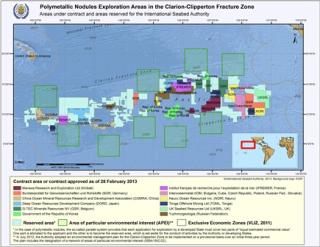
Source: http://www.isa.org.jm/en/scientific/exploration/maps
Map 2: Exploration Areas in the Indian Ocean
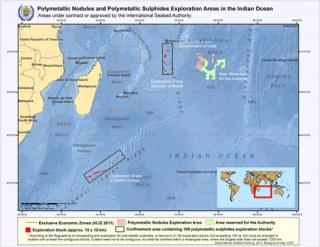
Source: http://www.isa.org.jm/en/scientific/exploration/maps
No estimates have been made of total global reserves with any precision, however to give some sense of the profusion the estimated reserves of seabed nodules is 500 billion tonnes as against terrestrial resources of 380 million tonnes.[vii] Nevertheless These figures must be viewed with circumspection since neither the density of yield nor the number of economically viable fields can be estimated other than to say that, if eligibility for mining is a yield of 10-15 kg per square metre and the approximation of number of sites is 225, then the total inferred resource is 13,500 million tonnes. Further considerations, including the cost of extraction and capacity of world metal markets to absorb production during the first 20 years will reduce viable numbers to 10 mines with an out put of 100–600 million tonnes (these figures remain speculative but are indicative of the resources that will fuel growth of large economies such as China and India).[viii]
Quandary of Strategic Expansion and Inversion
One of the twentieth century advocates of the realist school, Hans Morgenthau, writing on the principles of international relations underscored the importance of forces that have their roots in human nature in order to appreciate the correlation of States. And human nature, as Thucydides has pointed out is motivated by fear, self interest and honour. Realism, appeals to precedents and facts rather than abstractions and aims at the doable rather than the absolute.[ix] For all its rationality and righteousness the seabed regime with no enforcement powers would appear to have failed in the realism department. While examining the Yalu River conflict we took note of the alarming effect of a combination of imperial aspirations, blurred and uncertain authority, money and the military. These attributes are evident in the strategies of all the States that enjoy pioneer status in the Regime and may suggest the impending clash of interests in the deep seabed mining sector providing the potential for conflict over a new domain.
India’s venture into the field began over three decades ago (1981) when a deep sea expedition collected nodule samples and commenced an exploratory survey. The impetus for the endeavour was scientific and yet the commercial opportunities that it potentially offered was never lost sight of. It registered as a pioneer investor with the Authority in 1987 and was allocated an exploratory area of 300,000 square kilometres in the Central Indian Ocean Basin which was later relinquished to 150,000 square Kilometres. All the while necessary infrastructure and technologies have been generated for survey and exploration, fabrication of mining systems and development of extractive and metallurgical capabilities. The exertion is a national effort and one notes the ‘Yalu’ pattern of close linkage between national interests and ‘Inversion’.
The China-narrative follows much the same course and concept as India with a critical difference: growth is synonymous with survival of dispensation and access to raw materials that fuels growth is the key. No surprise that China devises access control and denial strategies for the Indian Ocean Region (IOR) and releases a “Blue Book” that outlines its policy and terms of engagement with the IOR littorals and exhorts pro-active efforts to secure its economic interests. In a break from the past China expresses its anxieties and fears (in the Morgenthauvian mould) that change and growth have precipitated and has underscored the “fragile balance of power” that exists in the IOR, which to any observer announces a calibrated emphasis on the security dimension.[x] Even a cursory examination of the news report suggests that not only is there forecast of overlapping interests, as they will be when exploitation of the deep seabed becomes a viable alternative, but also of the increased probability of friction that the introduction of military presence into the region will trigger. In sum we have the recipe to skew the existing status quo.
Cooperative Impulse to Security as a Conclusion
Expansion to imperial aspirations was the singular urge that found expression in the Yalu conflict of 1904. Today, China as with other large powers has devised strategies to exploit the economic opportunities that the globalised, technology driven world has placed on offer; but with a deviation that rejects mutuality and sees growth with “Chinese characteristics”, a euphemism for expansion on its terms, the nature of which the Chinese author Yasheng Huang has so graphically described as “…crony capitalism built on systemic corruption and raw political power.”[xi]
The cooperative impulse to security, which would serve to stabilise the seabed regime, through joint restraint and enforced regulation, is weak and as China’s power and ambitions grow, the points of conflict and differences will mount. Exploitation of deep seabed resources is one such point. While the balance-of-power consideration provides a modicum of stability, it is essentially an uncompromising defensive mechanism that serves as a tripwire for response when provocation is anticipated, it cannot replace cooperative processes. Fundamental to the durable functioning of the seabed regime is to set up unwavering regulatory processes that are enforceable by a security structure made up by the stake holders as represented by the investors awarded pioneer status. The very stakes that they have in the venture may catalyse action in this direction. A failure to impose such an arrangement on the International Seabed Authority will possibly witness the outcome of this enterprise to be not polymetallic nodules but friction that leads to armed conflict.
[i] Brodie, Bernard. War and Politcs, Macmillan New York, 1975, p. 286.
[ii] Staley, Eugene. War and the Private Investor. Doubleday Doran and Company Inc, New York 1935. Part I Chap 3
[iii] Paine S.C.M. Imperial Rivals: China, Russia and their disputed frontiers. ME Sharpe,Inc New York 1996 pgs 238-240
[iv] Staley, Eugene. War and the Private Investor. Doubleday Doran and Company Inc, New York 1935, p 57.
[v] A distortion of the words of General Smedley Butler as quoted by Brodie, Bernard in War and Politcs, Macmillan New York, 1975, p. 282.
[vi] See End Note 4.
[vii] Corather Lisa, US geological survey. GEOTIMES Mineral of the Month October 2005 energy and resources. Available at http://www.geotimes.org/oct05/resources.html
[viii] Polymetallic Nodules – International Seabed Authority http://www.isa.org.jm/files/documents/EN/Brochures/ENG7. Marine Mineral Resources Scientific Advances and Economic Perspectives, a joint Publication by the UN division of Ocean Affairs and the Law of the Sea, Office of Legal Affairs, and the ISA,2004. Pgs 84-90 and 103-104.
[ix] Morgenthau Hans, J. Politics Among Nations: The Struggle for Power and Peace. Alfred A, Knopf, 1978, p 4 to 15. The reference to Thucydides is made from Kaplan, Robert, The Revenge of Geography Random House New York, 2012, p. 24.
[x] Newspaper report. China Details Indian Ocean Strategy and Interests. The Hindu, 13 June 2013.
[xi] Huang, Yasheng. Capitalism with Chinese Characteristics. Cambridge University Press, New York, 2008 p. 236.

