
Pipe Dream or a Pathway to Shared Progress
By
Vice Admiral (Retd) Vijay Shankar (to be published)
Transcontinental Trade; from Shunya to Infinity
At the heart of ancient Eurasia was India-a culture that exported its diverse civilisation, creating around it a vast intellectual domain. Vedic mathematics, technology, astronomy, art, religions, music, dance, literature and an irrefutable concept of the nature of creation and Man’s place in a dynamic universe; all put together pioneered a new outlook to the meaning of things. These revelations wove a path around the world through the medium of commerce and communications, which stretched across the Arabian Sea over land and sea to Greece and Rome in the west, to China in the north and to South East Asia in the east. The impact of India’s civilizational evolution stimulated innovation and growth. From the largest temple in the world at Angkor Vat to the Buddhism of China, from trade with Mesopotamia and Greece to the creation of the decimal system that we use today; particularly the sublime understanding of zero and infinity. India transformed the culture and technology of the ancient world (as reconfirmed by recent archaeological finds at Berenike) “…excavations make clear that it’s no longer possible to think of the trans-ocean trade as a ‘Roman’ endeavour. By the first century A.D. India was one of the main powers in these transcontinental trade routes.” -That was till a millennium ago.
Strategic Course of Geopolitics
Writing in 1890, Sir Halford Mackinder , suggested that the course of politics is the product of two sets of forces, “Impelling and Guiding. Impetus originates from a nation’s past, from historical stimuli embedded in a people’s character and tradition. The present, Guides politics by economic realities and geographical opportunities. Statesmen and diplomats succeed and fail pretty much as they recognise the irresistible power of these forces.” This discernment of geopolitics and the dynamics that influence it, is far more elegant than some of the more contemporary understandings led by Henry Kissinger, Hans Morgenthau, Freidrich Ratzel and other advocates of Realpolitik. The latter suggested that geopolitics deals with power of a state and the will for domination; from this standpoint, lesser powers are condemned to the periphery. The governing doctrine was: national interests are best served through skilful manipulation by the State of the changing international balance of power. ‘National Interests’ in realpolitik is central and the art of the statesman is to strike equilibrium amongst competing interests through the instrument of power of the State.
Clearly, while Mackinder saw the past as a force of stimulation; it was the critical reality of the present and its circumstances that became the prime mover of a nation’s role in geopolitics; Kissinger and his ilk saw “national interests” and the quest for balancing power as the motive force powering geopolitics. Absent was that it also became the catalyst of antagonism amongst nations. The latter perception, left the lesser powers to be mere ‘camp-followers’ with the corollary belief that geopolitics was about antagonistic ‘Blocs’ with irreconcilable differences seeking to dominate each other.
Genesis: IMEC the Multimodal Logistic, Energy & Digital Highway
An Intergovernmental Framework Memorandum of Understanding was signed on 10 September, 2023 during the ‘Group of 20 nations’ summit held in New Delhi for a multimodal infrastructural corridor that bound together nations with common equitable purpose. The Project was born of a need for a trusty corridor that did not owe its existence to the control of any one dominant Power. It is driven by three objectives: first, to provide strategic transportation arteries that connect to existing sovereign networks and in turn facilitate uninterruptible movement of global trade and commerce by land and sea. Second, to lay a grid and system of pipelines that facilitates free flow of energy (renewable, fossil and hydrogen). Third, to institute a digital-highway that links the participating nations to national webs for streaming of financial transactions, information and knowledge. What is unmistakable about the enterprise but remains undeclared is its underlying intent as an equitable, dependable and preferable option to China’s Belt and Road Initiative (BRI) and to provide an alternative to the Suez Canal. The unique feature of the Corridor is the creation of a vast digital and energy highway in addition to arterial transportation freeways. The need and willingness to create an alternative to the extant and periodically troubled 195 Kilometre long Sea-Line of Communication running through the Suez Canal is a feature that harks back to the pre-First World War era.
Lesson from History: The Ill Fated Baghdad Bahn
In 1903, a concession to construct a railroad was awarded by the Ottoman Sultan Abdul Hamid II (1876-1909) to Germany. The strategic Berlin-Baghdad Railroad was conceived, designed and financed by Germany to exploit Ottoman pan-Islamism in order to threaten logistic networks from British India and isolate their Colonial possessions. The rail line, planned to connect Berlin with the Ottoman cities of Konya and Baghdad with a new 1,600 kilometres track through modern-day Turkey, Syria and Iraq, from where the German vision to establish a port in the Persian Gulf bypassing the Suez Canal could be realised.
The project was a manifestation of a dramatic growth of Kaiser’s economic clout. It played a role in the British-German trade rivalry, and in promoting hostility between the Entente and Central powers. Ironically the railway, on the one hand, helped unite the Entente powers against Germany; while on the other; led Germany into fear of encirclement and brought on World War I.
The scheme never fully fructified due British sponsored insurgencies in the vital Najd region of Saudi Arabia and technical glitches in the remote Taurus Mountains. Delays meant that by 1915 the railway was 480 kilometres short of completion, severely limiting its strategic utility during the war. The project failed on account of one critical consideration: the idea of strategic domination was not shared by the stake holders.
Is there a rude shock awaiting the IMEC? Is its timing so bedevilled that the enterprise may be consigned among the many lofty schemes that litter history, of well-meaning-but-star-crossed endeavours? Or can the project stand as a model for collaborative undertakings that disavow the impulse for domination?
Uncertainties of the Times
A change has occurred. A world that was inclined towards global order driven by growth, interdependence and globalisation, has been replaced by a return of legacy tensions reminiscent of the “Cold War”, quest for military solutions, manipulation of governments into well-disposed pliable regimes; and, paradoxically, growing insularity amongst nations characterise the contemporary milieu.
Self-indulgent ‘National Interests’ are at crossroads; while Balance-of-Power advocates find themselves on a limb when faced with eschewal of individual sacrifice in favour of less disruptive sequestered alternatives. A reality well-arranged for over three decades through power and political manipulation is in the process of morphing into a mire of geo-political risks.
Cementing Partnerships & Mobilising Finances
The Corridor is divided into three major segments India-UAE-Haifa-EU from where it links to the European Global Gateway Initiative (GGI); the aim of the GGI to open up the African continent complements that of the IMEC. The project envisions a two-part shipping and one overland route. Commerce from India would travel by sea to the United Arab Emirates (UAE), continue by rail/road through Saudi Arabia and Jordan to Israel’s Haifa port for onward shipment to destinations across the EU through links provided by the GGI. Bypassing the Suez Canal would substantially reduce time and cost.
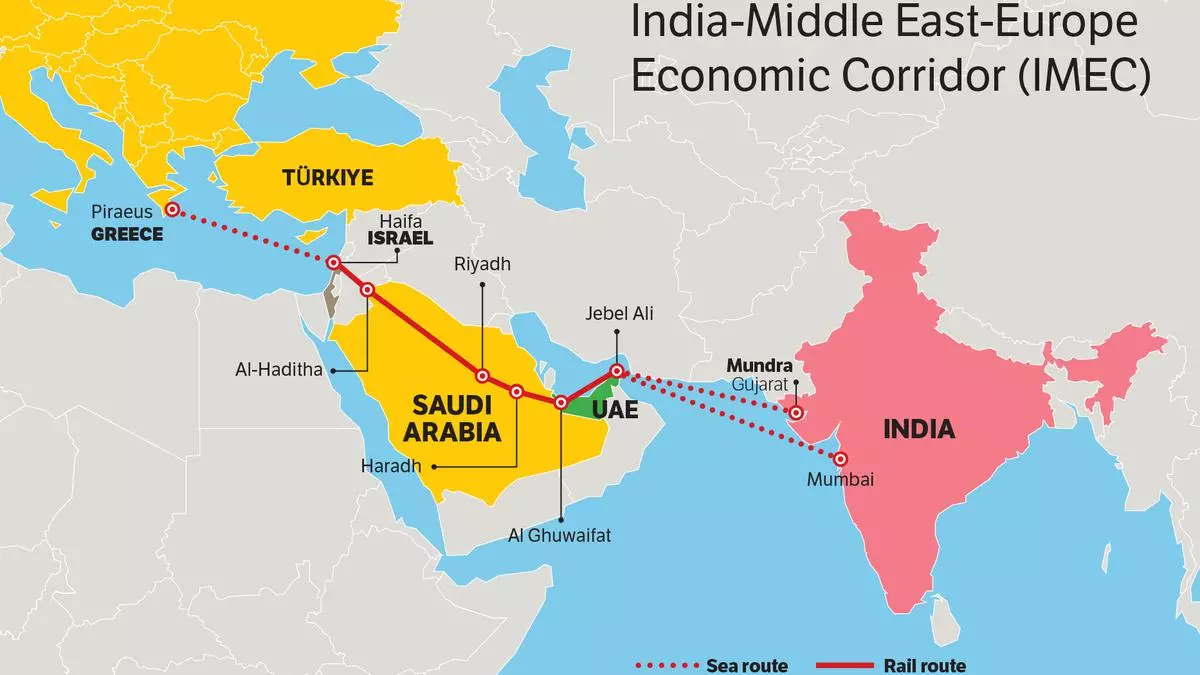
Improved relations between India and the Gulf countries, particularly the UAE and Saudi Arabia as a progression of the Abraham Accords of 2020 and the consolidation of the I2U2 grouping has culminated in strategic partnerships. Shared interests have expanded beyond oil exports from the Gulf and remittances from the 9 million Indian expats; to include food security, fertilisers, renewable energy and the health sector. The signing of the Comprehensive Economic Partnership Agreement (CEPA) between India and the UAE in 2022 highlights this emerging mutuality. The initiative estimates that the IMEC could cut the time to send goods from India to Europe by 40% and slash transit costs by 30%. The IMEC will also expand digital connectivity on the Arabian Peninsula, and give Europe and India new sources for clean gas and will through the GGI extend the benefits of the corridor to Africa and to trans-Atlantic states.
Noting the IMEC’s potential, Saudi Arabia and the UAE are major advocates of the Corridor. The motivation is in part geographical; Saudi Arabia and the UAE form a natural territorial bridge between India and Europe and is in part financial. The Saudi Crown Prince Muhammad Bin Salman has already pledged to invest $20 billion in the initiative. The IMEC also plans to establish a 20,000 kilometre cable system; the Trans Europe Asia System, to bolster under-sea and over land communication networks. This element of the Corridor is vital for improving the security of international data transmission.
The take-off, continuity, and flourishing of the IMEC are contingent upon several factors, the most critical of which is finance, de-risking and diversifying the project . Initial estimates suggest that the cost of each segment in the corridor can range anywhere between US$3 billion to US$8 billion. Securing the funding for this capital expenditure is a complex task as diverse participants are involved. Exploring effective and low-risk strategies for funding is important to attract private investments that are looking for stable risk-adjusted returns. However, the IMEC can lean upon the G7’s June 2023 commitment to mobilise US$600 billion in funding from private and public sources over five years. This initiative seeks to finance infrastructure development in emerging economies, serving as a strategic counter to the BRI. Furthermore, the ambitions of the IMEC to enhance the logistics of hydrogen energy are congruent with the strategic priorities of both the US and the EU, focusing on transitioning Europe’s energy reliance away from Russian fossil energy to clean eco-friendly sources.
Notwithstanding the prospective financial pledges, the introduction of Innovative Financing Instruments (IFI) will add to stability of investments and expenditure for the Project. IFIs may include the following five:
- Performance Contracting through State guarantees of future savings.
- Green Bonds that assure environmental benefits that may be monetised.
- Governmental level equity and, hybrid financing.
- Financing by linkages to geopolitical concerns such as security anxieties caused by ‘Grey Zone’ disruptions.
- Sum and Substance of the project may be summarised by the quintile policy: Productivity-People-Profits-Protection-Planet.
The IMEC thus seeks to create a comprehensive infrastructure network connecting countries with a combined GDP of US$47 trillion, encompassing shipping lanes, railways, roads, undersea cables, energy pipeline networks and solar grids. This initiative holds great potential to bolster global trade efficiency and ensure energy security. However, significant challenges exist. Building such a vast network requires overcoming political, financial and security hurdles. Regional conflicts and differing priorities create a complex and unsettled landscape. Additionally, competition with China’s BRI adds to insecurity as it may provoke inimical activities in the ‘Grey Zone’.
Political Risks Staring Down the IMEC
Two on-going wars, the assault on global supply chains, disruption of existing financial order, teetering of world-wide security structures, and the looming emergence of a revisionary and “rejuvenated” China; are all settings of contemporary geo-politics.
Global supply chains have been relentlessly breached by the wars in Ukraine and Gaza. Prior to the war in Ukraine, projections estimated global economic growth to be around 5%. The war, however, turned post- pandemic optimism to a “crippling economic shock”. A November 2022 report by the Organisation of Economic Cooperation & Development (OECD) suggested that it was the main factor that had slowed global economic growth to 2.2% in 2023. The conflict, the report added, had the greatest impact on Europe’s economy; where growth in 2023 was just 0.4% and in 2024 was 0.9%.
As a direct fall-out of the conflict in Gaza, drone strikes are being launched indiscriminately by rebel Houthis out of South Yemen targeting maritime traffic transiting the Straits of Bab-El Mandeb. The Straits and the Suez Canal are effectively shut to merchant traffic. As animmediate alternative, a ‘Land Corridor’ has been established to transport cargo off-loaded by sea at the UAE then transiting by road and rail across Saudi Arabia to Jordan, and terminating at Haifa in Israel. Use of the route was launched in late 2023. It provides a stand-in, albeit costlier, very limited and slower passageway that avoids the severely disrupted Red Sea route. Referred to as the ‘Land Connectivity by Trucks’ project, the America-backed corridor enables movement of containerised freight that cuts voyage time and cost around the Cape of Good Hope.
The long-term viability of the ‘Land Bridge’ depends both on regional stability and iron-clad endorsement from countries hosting sections of the route. Container transporters such as M/S Hapag-Lloyd, stated that the corridor could serve only as a short-term solution to sustain trade flow from ports which “would otherwise be cut off from their normal links to the global economy”. The questions that arise are: is the corridor sustainable? How stable is the region? At what cost and for how long can it be kept alive? What becomes of the cargo standing in queue?
Financial Order
Policy thinking on global financial order has, in the main, been shaped by whether one is a provider or a beneficiary and whether the beneficiary government is pliable. Since the end of the Second World War, the US centric bloc, both directly and indirectly, has held great influence over the rules and norms by which global finance is governed. However, the rise of China and other powers, the diminishing financial clout of the USA and a global retreat from free trade suggest that America may not have either the means or the remit to deal with global crises as effectively as it once did.
A globalised world will have to move beyond a zero sum transactional state if ‘universal prosperity’ is the purpose. The implication is: nations would by law avoid policies that have an adverse effect on countries from events instigated in another state or region. Events include man-made disasters, political crises, conflicts and wars. While it may be unrealistic to expect such “virtue-in-policy”, it remains the only way of managing risks threatening global financial stability.
IMEC is a complex project and has to be insulated against economic shocks and financial instability that lead to interventions of a nature (conflicts, sanctions and unfair trade practices) that could stifle a global enterprise such as it is.
Security Order in a Disquieting “Grey-Zone”
In the past it was the size of a nation, imperious resolve and access to resources that determined its wealth, power and control, particularly so in a closed mercantilist world economy as existed a century ago. In contemporary times the determinants may have changed but at its core it remains (with some exceptions) the same. Despite the importance of economics and diplomacy in the power of a state, traditional military might has not lost sway as the primary consideration of geopolitical heft. It is equally clear that interdependence and globalisation have failed to usher in the mythical future of soft power dominance. Instead, globalisation, as contemporary scenarios indicate, is held ransom by unbridled hard power. To believe otherwise is to succumb to a delusion in which resources are infinite, the quest for power dominance non-existent, warfare in the ‘Grey-Zone’ a fib and rogue states can be trusted to act honourably. ‘Soft’ interdependence has merely added to the list of vulnerabilities for the application of coercive power.
The ‘Grey-Zone’ describes a set of activities that occur between peace and armed conflict. A multitude of actions fall into this penumbric zone. They include clandestine disruptive economic activities, influence operations, cyber-attacks, mercenary operations and disinformation campaigns. Generally, grey-zone activities are instigated and executed by state actors, non-state actors, fifth columnists or those that abet them; they employ a combination of non-military and quasi-military tools that fall below the threshold of armed conflict. Aim being to thwart, destabilize, attack or persuade an adversary; they are invariably tailored towards the vulnerabilities of the target state.
Prime Minister Modi, in a meeting with President Putin on 15 September 2022 at the Shanghai Cooperation Organisation suggested that “this was not an era for war”. That pithy statement may have many interpretations, however, when viewed in the context of his now oft quoted concept of Vasudhaiva Kutumbkam , what may also be inferred is: rather than war and conquest promising an avenue for wealth, it is equitable and secure economic activity that is a more profitable path to economic well-being. Conquest, today, is an uncertain and risky endeavour, as the many wars of the 20th century have underscored.
Redefining Security
From this, a new definition of security emerges. National security has moved out of the restraining cocoon of just “defence of sovereignty of the State, its people and institutions”; to a far more nuanced perception that factors growth and development of the State along with the well-being and freedom of its people. And, critically, shielding the State from the impact of hostile Grey-Zone activities, intended to destabilise or strike at the vulnerabilities of the State. It is not as if the grey-zone was not exploited in the past but globalisation, interdependency and proliferation of technologies have made its impact far more severe a disrupter of systems and governments.
While there could be several snags to the Project intrinsic to the region, the principal impediments emanate from Beijing, not just because it perceives that “China is at the centre of the West’s war plans” (The hundred Year Marathon, Pillsbury), but because China contests alternatives to the BRI, claims ‘exceptionalism’ and more importantly because the IMEC poses a threat to China’s revisionary dream of a global order on its terms. Our examination will now focus on how the BRI has been weaponised, Beijing’s quest for exceptionalism and its promise of retribution for the “Century of Humiliation”.
Weaponising the BRI
The BRI represents a grand strategy conceived to promote a sense of Beijing’s distinctiveness through economic power; which it perceives as means to bring about political alignment of member countries (151) with China’s interests in order to re-orient the world economy and dependency towards China. Marketing of Beijing’s worldview is concomitant to the operation of Chinese soft power in a setting where the line between hard and soft is indistinct. In this context to employ economic means to subvert pliant dispensations and set “debt traps” is par-for-the-course. In the first ten years (2013-23) since launch of the BRI, China has invested or at least pledged $1trillion, some of which is on exclusive loan from the People’s Bank of China. Over 90% of the loans are to capital starved member countries from the lower income group that have questionable resources to pay back.
In Pakistan, the China-Pakistan-Economic-Corridor (CPEC) a ‘flag-ship’ part of the BRI infrastructure, loans came on seemingly favourable terms that ruled out competing lenders. Today, the state of the CPEC has had disastrous impact on the economy of that nation to the extent Pakistan minister for Planning has called for dissolution of the authority in control. Notwithstanding, Beijing views the project not in terms of economic benefit to the host nation, but as a strategic energy corridor to soothe their Malacca Dilemma, since the bulk of China’s insatiable energy demands and 90% of their trade transits through the Straits.
And so, China’s BRI is not just an instrument of economic heft, but a cudgel that has led to crippling indebtedness of 24 African nations of which five are significant as their debt is over 30% of government revenue; these include Angola, Ethiopia, Egypt, Nigeria and Kenya. While in Asia; Pakistan, Bangla-desh, Sri-Lanka and Myanmar find themselves in circumstances that has forced them to cede concessions in terms of infrastructure, territory and indeed polity. From China’s perspective, investments and possession of strategic locations help diversify China’s logistic network for critical resources. In effect the BRI has been weaponised.
Chinese Exceptionalism: To be Good & Great
The dazzling rise of China was fuelled by a misshapen American policy enshrined in the Shanghai Communiqué 1972. The much brandished purpose of this agreement was to upend the Sino-Soviet alliance in the Cold War. The underlying belief was that the recognition of ‘One-China’ and the provision of massive economic, military, science and technology support would irreparably fracture the overwrought Sino-Soviet relations and bring Beijing into the ‘liberal’ western world order. China on its part used and overturned this belief through deception, emulation and exploitation. Since then, not only have China and Russia set aside their differences of the 1960s; but have become more assertive internationally and far more unpredictable. China the more dominant of the two, today stands on the cusp of challenging the acknowledged global hegemon.
The growth of China has been accompanied by ‘self-attributed’ virtues of being both “Good” and “Great”. By emphasising these abstract features it seeks to provide Beijing the right to ‘exceptionalism’ in its choice to chart a unique course on the geopolitical map. The manifestations are clear as defined by claims of ‘Rejuvenation’ that would not only bestow justice to Beijing for its ‘century of humiliation’, but also enable a revisionary approach to global governance. China suggests that by comparison, the existing hegemon has an offensive militaristic face intent on control of global economic systems and unquestioned predominance over geopolitical influence. Beijing’s brand of exceptionalism purports to be, more friendly, defensive and benevolent. The problem really is will global audiences concede the value of Beijing’s political norms? And whether the Chinese approach to use its perceived civilizational experience (great as it may be) for defining an alternative global order, finds legitimacy amongst the comity of nations?
Means: The Thirty Six Stratagems
The “Thirty-Six Stratagems” is a Chinese collation of maxims that outline artifices for use in politics, war, and civil relations. Its focus is on beguiling an adversary. Compiled as a corpus of proverbs during the Ming era in China (1368-1644); the aphorisms are bereft of scruples and provide a template for success through ruthlessness, subterfuge and an antiquated sense of civilizational order.
Many of the ‘thirty-six’ are disquieting in their significance. Take for example the following: “kill with borrowed knife”; “loot a burning house” or even “hide a knife behind a smile”; suggest treachery in dealings. While others such as “befriend a distant state and strike a neighbouring one”; “replace the beams with rotten timbers”; “feign madness but keep your balance”; “remove the ladder when the enemy has ascended to the roof” all ring a note of chicanery in international relations.
The society that Beijing has moulded is collectivist in character; wherein the Party is morally, politically and economically the master of the individual and therefore the sway of the ‘Thirty Six’. This is not hard to understand given the CCP’s abstract views on national prestige, interests and the ability to differentiate between the State and its citizenry that accommodates the existence of a chasm between elitist constructs of domination and the reality of trials that the citizen may face. Collectivism promotes the idea that the individual is an appendage of a larger and more critical entity, the CCP. The ‘Stratagems’ may advocate an archaic text for villainy; but what is disturbing is that Beijing has employed several of the ‘thirty-six’ in their international transactions with “friends” and adversaries alike. Conventional wisdom suggests clichés from old patterns of warfare are out of harmony with modern perspectives on conflict. And yet paradoxically, Beijing persists with their usage. In the run-up to the Sino-Indian war, they lulled PM Nehru into believing that their relationship was fraternal before they invaded in 1962; during the cold-war they manipulated the Americans and the Soviets, as tools for their own advancement and global ambitions. After the USSR collapsed, they deceived the USA that partnership with them was to their mutual benefit, till they attained adequate power today to contest them. On the commercial front they have ensnared nations in debt traps through their brand of predatory economics.
Nudging the South China Sea to the Brink
In the South China Sea (SCS), Beijing’s aggressiveness has resulted in heightened tensions with all the littorals, particularly Japan, Vietnam and the Philippines. Their sweeping claims of sovereignty over the SCS within its contrived ‘Nine-Dash-Line’ and arrogating rights to the sea’s estimated reserves of 11 billion barrels of untapped oil and 190 trillion cubic feet of natural gas have antagonized legitimate claimants Brunei, Indonesia, Malaysia, the Philippines, Taiwan, and Vietnam; who under the UN Convention of the Law of the Sea (UNCLOS), not only have freedom of navigation, but also the license to exploit their EEZs. In July 2016, the Permanent Court of Arbitration at The Hague ruled in favour of the Philippines, rubbishing the Nine Dash Line entitlement. China, however, despite having ratified the UNCLOS; rejects the Court’s authority.
In recent years, imagery has exposed China’s efforts to reclaim land in the SCS and even creating artificial ones. It has constructed ports, military installations, and airstrips—particularly in the Paracel and Spratly Islands. In the Woody Island it has deployed fighter jets, cruise missiles, and surveillance systems. Beijing’s claim to the SCS portends control over commerce and energy flow; an eventuality intolerable to not just the littorals, but to the world. To protect their interests in the region, nations have challenged China’s aggressive territorial claims and land reclamation policies. Amid rising tensions, claims, bullying, hindering legitimate economic activities and establishing unlawful Air Defence Identification Zones; there is a rapid military build-up in the region that has pushed the Indo-Pacific closer to the brink.
Nature of Potential Conflict
Three features of Beijing’s revisionary aspirations are potentially in conflict with the IMEC. As mentioned earlier these are: China’s quest for exceptionalism; weaponising of the BRI and aggressive militarism in the SCS. Exceptionalism pressures a posture that places the claimant above laws, conventions and agreements; it is backed by power and a willingness to undermine any resistance to its order of things. Beijing repudiates alternatives to its perspective through means that play out in the ‘Grey-Zone’ and counts on its exceptionalism to make legal their domestic and international politics. For, legitimacy confers on the CCP the exclusive right to enforce policy both internally and externally. However, centralized control also places sole responsibility on leadership when outcomes digress from rhetoric. Legitimacy is the CCP’s “Centre of Gravity”; mismanagement of narratives and a failure to sustain prosperity coupled with simmering discontent, as witnessed during the Zero-COVID policy, will strike at their Centre of gravity and severely impact the Party and its vision of exceptionalism.
Riposte to the Challenge Posed by China
The most substantial vulnerability is the CCP’s legitimacy and its inconsistent narrative, particularly on the international stage. Idealistic phrases like ‘harmony, peaceful coexistence and non-interference with Chinese characteristics’ employed by the Party to portray China as a benevolent power, stand in stark contrast to the reality of their predatory economic practises and usurping of sovereign territories. Beijing’s actions in the SCS provide a glaring example of simultaneously professing adherence to international law while deliberately subverting it.
The second vulnerability is Beijing’s ideology which perceives international laws, conventions and protocols to be no more than contrivances for consolidating power and justifying its arbitrary use. The masses are often willing to endure repressive control if their living standards remain reasonable, especially when those standards continue to rise, as has been the case in recent years. As noted in the context of China being ‘good, great and exceptional,’ once a pattern of upward mobility becomes the norm, economic growth is expected. Susceptibilities arise when growth declines or encounters setbacks. Moreover, inconsistencies in ideology serve to undermine it. In the CCP, clear class distinctions between the affluence of the Party and the proletariat are a contradiction that cannot be bridged and in times of crises neither will the proscription of the individual in favour of the Party be tolerated beyond a limit. Such discrepancies erode the foundations of control and when coupled with simmering discontent, as witnessed during the Zero-COVID policy protests, can fracture the nation.
Beijing understands power and how to leverage it. The CCP’s natural fear lies in the fact that nations recognise its ambitions for what it is; of revisionism and exceptionalism. So measures taken to show willingness to face up to the challenge of Beijing through groupings that provide alternatives, such as the IMEC, will give pause to temper their bellicose approach to the abuse of either economic or military muscle.
The Strength of Banding Connectivity
In the conviction that the world is facing an existential threat from China, the lone hegemon has brought together a consortium of nations that are opposed to the idea of a revisionary disruption to the current global order. Thus far several groupings such as the QUAD and the AUKUS, are in place to contend with the strategic posture adopted by China. While there intent may appear reminiscent of the policy of ‘Containment’ from the Cold War era, they must be perceived as “what they signify and add up to, rather than who they oppose”.
At the strategic level, the IMEC aims for a vast region of the world to band closer together through economic connectivity and partnerships. Simultaneously, the corridor would provide a boost to India and the region’s strategy for growth. The UAE and Saudi Arabia embrace IMEC as part of their push to become an economic bridge between East and West. The EU stands to gain from this enterprise to wean itself away from dependence on China and re-engage with the nations of the African continent. While the world at large will benefit from a more efficient and less vulnerable trade, energy and digital corridor than the Suez. For the IMEC to fulfil its potential, the participants will need to coalesce around implementation plans that can reconcile the Projects many goals. They will also need to overcome internal and external obstacles to the corridor.
Conclusion
Historically, growth and prosperity were linked to a distinctive military culture that stressed on discipline, mercenary practices and exploitation. Particularly so, when conquest fetched territory, resources and colonies. The problem in the modern era with such a notion is that the same beliefs usher destruction, loot and strife; leaving protagonists exhausted and bereft of a blueprint for either reconciliation or growth. On the contrary, they are left with a legacy of unresolved conflicts. Wars of the 20th and now the 21st centuries stand in mute testimony to this.
The failure of the Berlin-Baghdad Rail link has been attributed to many reasons these include confrontational politics of that time, poor management and technological challenges. However most significant was the weaponising of what was intended to be a transnational infrastructural project and the design to mix economics with domination.
At the heart of realising success in the IMEC project is neither military power nor control nor even domination; but of advancement of a political ethos that harmonises the needs of the many collaborators and assurance of equitability and security. Underpinning precept is that ‘more the stakeholders, more the thrust for stability. To put it succinctly: “Productivity-People-Profits-Protection-Planet”.
Unfortunately strategic planners rarely occupy themselves with the higher problems of growth and international relations; rather, are content with the narrow outcome of either fulfilment of a political directive; attainment of a tactical goal or even realisation of a self-seeking purpose, blind to the validity that success is a function of sculpting a holistic strategy that elevates various instruments of power alongside traditional military deterrence.
 Strategic Dialogues