The Misshapen Pivot

By

Vice Admiral (retd) Vijay Shankar 

(This article was first published in the Institute of Peace and Conflict Studies web site on 21 October 2016 and may be accessed at  http://www.ipcs.org/article/china/the-misshapen-pivot-5158.html )

We note, with some, anxiety an unmistakable parallel to the current situation in the Western Pacific with what obtained in the run-up to the 20th Century. An impending face-off between a rising and revisionist China against a loose entente of status-quo powers led by a deflected USA that has set itself the task to pivot into the region and rebalance the strategic situation. All this at a time of convulsions in West Asia and global uncertainty. For the pivot to flounder is to legitimize Chinese illegal actions.

Lessons of History

The world of empires of the 18th and 19th centuries were remarkably well connected, willing to strike compromises that did not upend the status-quo and in turn enjoyed slanted stability. Imperialism of the 19th century thrust political, financial, economic, scientific and religious institutions that we see as underpinning the world system to this day. But beneath this global order run widespread fault lines that can invariably be linked to the nature of the expansionist impulse.

In 1894 China and Japan went to war. The conflict was significant for it marked the first time that a host of imperial powers would become directly involved in a struggle between two sovereign nations far from their own shores. Regardless of how these powers felt about each other, they had strong mercantile interests based solely on open access to China. Victorious Japan sought exclusive hold over China’s Liaotung peninsula as part of the 1895 Treaty of Shimonoseki. Russia, Germany and France all felt that conditions imposed by the Treaty placed in jeopardy their own commercial interests and consequently threatened war unless Japan backed down. In the event Japan surrendered its claim to Liaotung in return for a free hand in Korea and increased war reparations from China. Within two years Great Britain, Germany and France sensing the weakness of The Qing Empire capitalised on the political and economic opportunities and took control of vast local regions. China thereafter rapidly began to fall apart; it suffered two more imperial wars: suppression of the Boxer Rebellion in 1900 and war between Russia and Japan in 1904-05 over ambitions in Korea and Manchuria. Battles were fought on Chinese soil and in the waters of the East and South China Sea. Imperial competition and ‘cozy arrangements’ in the region, as James Joll has pointed out, provided one more enticement for the coming First World War.

The Tearing Tectonic

In coming to grips with that tumultuous period in East Asia a convergence of three geopolitical fault lines may be discerned beneath the larger rift that had been caused by the decay and degeneration of the Qing Empire. The end of Empire generated in China political stresses which pulled apart the state almost in terms of a geological ‘Tearing Tectonic’. While three fault lines: an emerging imperial power in the form of Japan, intervention of existing rival colonial powers sensing large commercial and magistracy interests and the decline of an existing centre of power in Russia simultaneously fractured to release energies that catalysed the speedy collapse of the ‘middle kingdom’.

A French political cartoon from 1898 is most illustrative of the situation. A pastry “Chine” is being divided between Queen Victoria, the German Kaiser, Nicholas II of Russia, the French Marianne cozying-up to the Czar and a Samurai Japan. A powerless Qing official throws up his hands.

571px-china_imperialism_cartoon

En Chine Le gâteau des Rois et… des Empereurs” “Le Petit Journal”, 16th January 1898

The Unmistakable Parallel

As we examine contemporary geopolitics of the East Asian region we note with some anxiety an unmistakable parallel to the situation that obtained in the run-up to the Twentieth Century with a switch in the main protagonists. The fault lines against a backdrop of a global rift of uncertainty are all discernable.  A rising and revisionist China sensing opportunity for hegemony in the region confronted by a potential entente of status-quo powers, more than likely to include Japan, Australia and India; led by a deflected and hesitant USA, all to the exclusion of a declining and sulking Russia.  This at a time of great convulsions in West Asia when the strategic paradigm of the day (if there is one) is the tensions of the multi polar; the tyranny of a techno-economic combine in conflict with politics of the state; the anarchy of expectations; and polarization of peoples along religio-cultural lines all compacted in the cauldron of globalization. An uncertain geo-political brew, as the world had never seen before, has come to pass under the shadow of the proliferation of nuclear weapons.

The Strategic Pivot

The “strategic pivot” or rebalancing, launched in 2009 by the Obama government, is premised on the recognition that a disproportionate share of political tensions and economic history of the 21st century will be written in the Asia-Pacific region. The key tenet of this strategic reorientation is the need to cultivate a stable and predictable political, economic, and security environment across a region spanning the Indian Ocean to the West Pacific. Unsaid is the central dynamic to build an Entente to contain and balance the rise of China. The military component of the pivot cannot be overemphasized and remains the abiding driver of policy in the region. The strategic importance of the pivot derives from the increased collective concern about China’s military modernization and its larger revisionist objectives.

Theoretically the Asia-Pacific pivot makes strategic sense. However, there is sloth in implementation influenced to some extent, by the situation in West Asia and the unfinished business of Afghanistan and Iraq. Yet allowing these distractions to dilute the strategic priority of the Asia-Pacific could well run the hazard of accelerating a return to an ‘atavistic actuation’ that threatens global stability. As events have unfolded, sloth has granted China a fortuitous time-window to prepare for the impending encounter. It also explains China’s impious haste in development of military infrastructure and artificial islands in the South and East China Sea, operationalizing “Access Denial” strategies, declaring proprietary sea lanes of communication and Air Defence Identification Zones and a cavalier attitude towards The Hague’s verdict on claims in these seas.

Conclusion

The absence of a direct challenge to China’s provocative moves on the East and South China Seas, despite the fact that fundamental principles of international order have been defied, is to allow the idea of the strategic pivot to flounder. This will provide space to China to progress with its own unhinged scheme of a “New Model on Great Power Relations” that creates a de-facto G2 and works to marginalizing of other major stake holders in regional security. Besides such a scheme legitimises China’s claims in the South and East China Sea and in a manners anoints it as the recognised regional hegemon and a ‘system shaper’; suggesting a return to a situation analogous to the pre-20th Century context.

South China Sea: China’s Double Speak and Verdict at The Hague

By

Vice Admiral (retd) Vijay Shankar

When Premier Xi rubbished the 12 July 2016 verdict of the International Permanent Court of Arbitration at The Hague on China’s claims over most of the South China Sea, what exactly was meant? For no international justice system had thus far ever called China to order for its expansionist strategy.

What the Hague had in fact done was not only to uphold the case filed by the Philippines in 2013, after China seized a reef in the Scarborough Shoal; but also condemned China’s conduct in the South China Sea over construction of artificial islands and setting up military infrastructure. In an unequivocal rebuke, it found China’s expansive claim to sovereignty over the waters had no legal basis, historical or otherwise. The verdict gives motivation to the governments of Brunei, Indonesia, Malaysia, Vietnam and Taiwan to pursue their maritime disputes with Beijing in the Permanent Court of Arbitration (PCA). Small wonder then is Premier Xi’s fulmination.

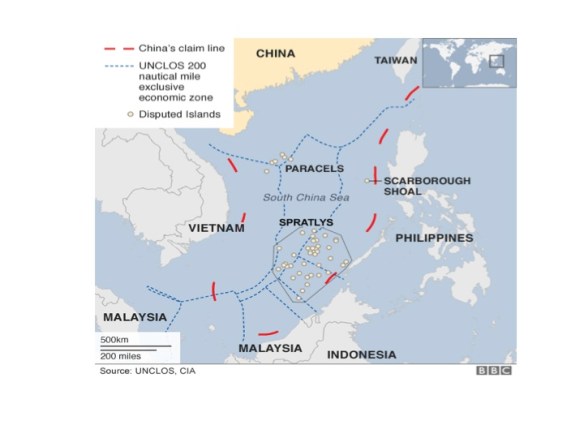
The central issue before the PCA was the legality of China’s claim to waters within a, so called, “nine-dash line” that appears on official Chinese charts. It encircles 90 per cent of the South China Sea, an area of 1.9 million square kilometres approximately equal to the combined areas of Afghanistan, Pakistan and Myanmar put together. Philippines contention was that China’s claims were in violation of the United Nations Convention on the Law of the Sea (UNCLOS), which both China and the Philippines have ratified. In its decision, the tribunal said any historic rights to the sea that China claimed “were extinguished” by the treaty. And its failure to be a party to the deliberations in no way bars the proceedings. The UNCLOS lays out rules for drawing zones of control over the world’s oceans and seas based on coastal orientation. While the concept of Historic Waters means waters which are treated as internal waters where there is no right of innocent passage.

As far as the “nine-dash line” (originally eleven-dash) is concerned; following the surrender of Japan in 1945, China produced a proprietorship chart titled “Position of the South China Sea Islands” that showed an eleven-dash line around the islands. This map was published by the Republic of China government in February 1948. It did not hold onto this position after it fled to Taiwan. The Chinese Communist Party, however persisted with this cartographic notion, modifying the 11 to 9 dashes when in 1957, China ceded Bailongwei Island in the Gulf of Tonkin to North Vietnam.

Map: The Nine-Dash Line  Slide1

Source: BBC.CO.UK

The PCA concluded that China had never exercised exclusive authority over the waters and that several disputed rocks and reefs in the South China Sea were too small for China to claim control of economic activities in the waters around them. As a result, it found, China outside the law in as much as activities in Philippine waters are concerned. The tribunal cited China’s construction of artificial islands on the Mischief Reef and the Spratly archipelago as illegal in addition to the military facilities thereon which were all in Philippine waters.

The episode has besmirched the image of Xi Jinping, his politburo and indeed the credibility of the Communist Party of China (CPC). Tolose their legal case for sovereignty over waters that they have heavily invested in must come as a rude shock to their global aspirations. A complaisant response may set into motion the unravelling of the CPC’s internal hold on the state as defence of maritime claims is central to the Communist Party’s narrative. Any challenge to this account is seen in Beijing as a challenge to the Party’s rule. But the die has been cast; it remains to be seen how more regions and neighbours respond to China’s unlawful claims wherever it is perceived to exist. An indication of the regional response was Vietnam’s immediate endorsement of the tribunal’s decision.

Thus far China has responded sardonically with a typical Cold War propagandist style avowal “We do not claim an inch of land that does not belong to us, but we won’t give up any patch that is ours. The activities of the Chinese people in the South China Sea date back to over 2,000 years ago.” said the front-page in The People’s Daily, which ridiculed the tribunal as a “lackey of some outside forces” that would be remembered as a “laughingstock in human history.” Such dippy doublespeak has no place in contemporary geopolitics. For China to do nothing about the matter will be difficult in the extreme. It does not take a political pundit to note that some form of immediate coercive military manoeuvre in the South China Sea is in the offing. Also, it would hardly be realistic to expect China to scurry away to dismantle the military infrastructure it has so far set up; more likely it is their revisionist policies that would be reviewed.

Towards the end of the Cultural Revolution, in 1976, China brought out a movie titled “Great Wall in the South China Sea,” it was not about the inward looking narrative of Chinese civilization but of “expansive conquests that would knit together all of South East Asia.” The Hague’s verdict has grievously injured the latter strategy. And if the free world is to rein in China’s bid to rewrite the rule books including the right to unimpeded passage in the South China Sea then, it would do well to convince her of the illegitimacy of her position. In the meantime Indian diplomacy should promote the littorals of the South China Sea to seek arbitration for their maritime disputes with China at The Hague.

There is a New Symphony at Play

By

Vice Admiral (retd.) Vijay Shankar

(This article was first published on the IPCS website on 22/06/2016)

Change, more often than not, is driven by circumstances rather than scholastic deliberation. As President Obama once put it, perhaps as an unintended barb to the legions of geo-political seers that stalk Massachusetts Avenue, Washington DC, “Change doesn’t come from Washington but comes to Washington.” So it was with Prime Minister Modi’s three-day state visit to the USA (6th June to 8th June 2016). Not only did the visit lay the foundation to several strategic goals mutual to both sides, but was also punctuated by symbolism that provides a basis for the future. When Modi suggested stepping out of the “shadows of hesitations of the past” he could not have stated in more unequivocal terms that India’s strategic orientation was now one that not only respected the status quo, but also would contribute towards ensuring that attempts to upset it would not go unchallenged. At the same time laying a floral wreath at Arlington Cemetery to the Tomb of the Unknowns (a first for an Indian PM), on the face of it, was a tribute to that one unquestioning instrument of state power who historically has laid down his all for a national cause. Underlying the salute was recognition of the role played by the military in binding and stabilizing an uncertain security milieu.

Two salients of his visit are particularly significant. Seemingly disparate, they share a geo-political outcome that aggregates to stability in world order. The first is measures to bring about strategic equilibrium in the Indo-Pacific and the second, India’s admission into the Nuclear Suppliers Group (NSG) as a step in support of stability in global nuclear politics and commerce.

Mahan in The Influence of Sea power upon History underscored several prescient perspectives relating to the Global Commons. His treatise submitted that competition for materials and markets is intrinsic to an ever trussed global system. Inferring that the nature of commerce on the one hand deters conflicts, while on the other engenders friction; the oceanic routes and ports of access had to be assured. And then he went on to advocate that the Commons require to be warranted against hegemony, disruption and rapacious exploitation. These perspectives today ring a reality whose significance has not entirely been lost on the Prime Minister.

Typically the Global Commons describe international and supranational resource domains. It includes the earth’s shared resources, such as the oceans, the atmosphere, outer space and the Polar Regions. Cyberspace also meets current discernment. It is hardly coincident that it is in these very domains that China has shown aggressive intent. PM Modi’s understanding of contemporary dynamics in the Commons and the need to balance out China’s objectives of hegemonic control through strategic security partnerships is adroit. The current distressed state of the Commons is marked by the impact that globalization has had: strains of multi-polarity, anarchy of expectations and increasing tensions between demands for economic integration and stresses of fractured political divisions are all symptoms. Nations are persistently confronted by the need to reconcile internal pressures with intrusive external impulses at a time when the efficacy of military power to bring on positive political outcomes is in question. While most nations have sought resolution and correctives within the framework of the existing international order, China emerges as an irony that has angled for and conspired to re-write the rule book. In this context the PM’s statement to Congress that it was only strong Indo-US ties that could anchor security in the Indo-Pacific Region left little to speculate what direction relations were taking and the extent of mutuality that was perceived in the Logistic Support Agreement being fleshed out. Not only is India preparing for strategic collaboration with the US, but is buttressing its posture in the Indo-Pacific through multilateral cooperation with ASEAN. All this must be seen as its intent to institutionalise its presence in the waters of the Indo-Pacific.

Critics, maintain that scripting an international security relationship with the US flies in the face of autonomy in global affairs. In response one only has to note the transformed conditions of world order of the day which is far removed from that which existed between the post-World War II era to the end of the Cold War. Uncertainties of events and their multi-faceted impact reflect the new substance of increased global interdependence in every field of endeavour. Whether these fields are in the economic, political or security domains, corollary imperatives are interlinked at the national, regional and international levels.

Reports on the run-up to the plenary session of the Nuclear Suppliers Group (NSG) held at Seoul on 24 June 2016 suggest that the US and Russia along with 36 other member countries (total 48) have expressed support for India’s admission to the Group largely as a result of 3 considerations: India’s clean track record of non-proliferation; American, Russian along with majority support; and the lure of commercial gain. But China is resisting admission on the basis of a curious principle – that before any decision is taken about India’s membership, the NSG needs to agree on equitable and non-discriminatory criteria for membership of those countries that are nuclear weapon states (for “those countries” read Pakistan), but are not signatories of the Non-Proliferation Treaty (NPT). China argues that if any exception to the conditions for admission is to be made, then it should apply equally to both India and Pakistan. As a counter argument, accession to the NPT is not a criterion for membership — France was not a member of the NPT until 1992 though it was a founder member of the NSG in 1975. On the second rule condition — a good non-proliferation record; India has a better history than some of the NSG members. Particularly China, given membership in 2004, has debatably the most dubious proliferation record whether it is their dealings with Pakistan or North Korea. For that matter, equating the Indian and Pakistani applications for membership, as China has done, is disingenuous. Pakistan, while gloating that it has “successfully” blocked India’s bid to gain membership of the NSG, has not made a case worth examining. The United States in the meantime has apparently divulged some pretty damning information that entities of the Pakistan Atomic Energy Commission have continued to be in violation of UN sanctions as they supply restricted items and equipment with a direct bearing on the production of nuclear weapons to North Korea. China has been in the know of this information all along and may have been party to this fresh case of clandestine proliferation. So now the question that begs to be asked is, with what credibility does China obstruct India’s entry?! India has never had a state sponsored AQ Khan nuclear black-market network extending from Libya to North Korea nor sold nuclear technology to third parties nor been a persistent proliferator of nuclear technology. For China to have overlooked all this including the fact that, as Modi put it to the US Congress, all global terrorism is “incubated” in India’s neighbourhood (meaning Pakistan); must speak of China’s own veracity within the group.

What are the stakes involved? For India, the logical sequel to the Indo-US civil nuclear agreement of 2008 and the concomitant NSG waiver followed by entry into the Missile Technology Control Regime is membership of the NSG; for this will not only give total legitimacy to India’s nuclear aspirations but also, by entering the larger nuclear establishment, it will substantially contribute towards global nuclear stability. It also provides regulated and unimpeded access to technology. However, has China’s stonewalling worked? Given the circumstances that China finds itself in, clearly, not for long.  Also, New Delhi has thrown the gauntlet to China in a manner that most states are hesitant to in recent times; it’s flanking bid to gain entry to the NSG despite China, is suggesting new terms for global nuclear politics. The good news is that she carries the weight of more than 38 members in support including all major players. The initiation of an informal consultative process chaired by the outgoing chairperson of the NSG (who was actively involved in promoting India’s case) to continue examination of India’s basis for admission and the US continued advancement of the case are indicative of things to come.

In the event, India did not gain entry into the NSG during the June plenary. However, the robust thrust on the issue underscores a critical refrain: that the long-held perceptions of Indian foreign policy being ineffectual, non-aligned, placatory and unable to shape geo-political events are a thing of the past. That India will gain entry into the NSG, with the support it has garnered, is a foregone conclusion if not now, most certainly in the immediate future. If there are delays, it is solely due to China’s obstinacy, which is double edged, for it exposes to the world that China has no intention of accommodating Indian aspirations in favour of promoting ‘questionable’ interests and remains indifferent to the idea of mutuality. In this context, one must not so easily forget the lessons of the lead-in to the Sino-Indian war of 1962. The Indian plea in 1960 to arrive at a border agreement amicably based on all that India had done to gain China’s communist government legitimacy despite invasion of Tibet and Korea, fell on (Prime Minister Chou En-lai’s) deaf ears. If there is one lesson to be learned from China’s machinations, it is that the Politburo respects power and has scant respect for history or for any rule book that is not self-serving. Events in the South China Sea, making chattels of sea lines of communication and points of ingress of trade, brooking no competition where access to resources is concerned are all a continuum of its unrelenting march to strategic control; and this march cannot but look askance at the emerging challenge of India’s endeavours. For India’s foreign policy establishment, this must be seen as a fortuitous setting to find itself in provided it continuously questions China for its autocratic ways, its territorial thirst, its nuclear proliferatory dealings with Pakistan and North Korea, its disregard for the hazards of global terror and critically the legitimacy of its leadership. It is only then that India can proactively be a factor in global outcomes. Moves to stage a lateral entry into the NSG, securing Indo-US partnership in the interest of bringing about a strategic equilibrium in the Indo-Pacific and gaining membership to the MTCR are all symptomatic that India’s foreign policy and posture have come of age.

Observing recent events the prolific poet and realist, Walt Whitman, would agree that “now that the orchestra have sufficiently tuned their instruments and the baton has given the signal to play” Modi’s addendum that it “was best that a new symphony be played” is most appropriate.