The 1984 Archetype: China’s New Form of Human Civilization

By

Vice Admiral (retd) Vijay Shankar

Interminable Wars

George Orwell’s “Nineteen Eighty-Four” depicts a dystopian society in which the super-state of Oceania is steeped in totalitarianism and perpetual war. In Oceania’s state of ceaseless conflict with either Eastasia or Eurasia, the ruling Regime holds a monopoly on violence and its unending wars are a part of a mechanism to maintain control over its citizens. This persevering condition unifies the population in the face of a common enemy, justifies unquestioningly the need for strict government regulation and diverts resources away from bringing about changes in the lives of the people. Reality itself is pliable, in a fluid sense, and exists only in the mind; and therefore the core axiom of the state was bending and manipulating the mind. Additionally, the regime’s efficient use of the secret ‘thought police’ for guileful suppression of its citizenry, structuring a bureaucracy that not only monopolises facts but also determines the past to model a present and a future of its fabrication while its agencies desensitise generations of citizenry to accept a reality of its making by continuously changing it. As George Orwell put it, “by a lack of understanding they (the citizenry) remained sane”. As for the interminable wars; there never was intended to be any winner or loser, no pitched battles, no blunders, no surrender; just an instrument to enable a miserable war economy and a reason for mind-bending oversight.

By constantly altering historical records and presenting false information as fact; a world is created in which the objectivity of truth ceases to exist. This manipulation allows the regime to shape citizens’ beliefs and perceptions according to their agenda. The theme of language-engineering and therefore constriction of ideas is enforced by the creation of “Newspeak” that highlights the power of language and rhetoric to shape perceptions and control thought. In the novel, ‘Newspeak’ is designed to limit expression and eliminate dissent by restricting vocabulary and simplifying grammar. Similarly, in contemporary politics, language can be used to manipulate public opinion; through the ubiquitous tweet, frame debates, and obfuscate the truth. Politicians and public figures may employ euphemisms, Doublespeak, and carefully crafted messaging to influence people’s dogmas and actions. The novel underscores the manner in which these linguistic tactics can shape the mind of the listener.

Reality, censorship and control of information in 1984 strike a dangerous harmony with contemporary issues of media management and peddling “fake news.” In the novel, the establishment constantly bridles facts to create and maintain its current version of reality. Similarly, in today’s world, the spread of misinformation, biased reporting, and outright falsehoods through social media and other channels can mould public opinion, undermine trust in institutions and indeed, change the idea of actuality itself. Transformation of reality, as E.M. Forester put it, was “at the turn of the kaleidoscope”; much as leadership of a current superpower has so vividly shown.   

In Nineteen Eighty-Four, propaganda and indoctrination are central to the Government’s ability to maintain control and suppress dissent. The State uses various methods, including controlling media, and promoting an overarching ideology that justifies its actions. This portrayal is relevant to contemporary concerns about the influence of ideologies and radical beliefs on society. Today, we see the rise of various extremist groups and the spread of their beliefs through online platforms and social media. These groups often employ spin-doctoring and brainwashing techniques to recruit members, gain influence and motivate them even to the extent of suicide bombing.  

War and the perversion of its significance from “extension of politics by other means” is refined to denote a stable state of conflict that ensures the perpetual churning of the wheels of military industry in Oceania’s interminable yet finely tuned wars against the other two super states of Eurasia and Eastasia. The aim is to achieve a balanced condition of disorder that neither seeks gains nor strives for victory; but pursues relentless power and control of their citizenry. The goal is to impress upon the populace the persuasion that “War is Peace”.  The concept of perpetual war in 1984, serves as the prime mechanism for the Regime to maintain its sway over the populace. In today’s world, we can see parallels with on-going global conflicts and the manner in which war is used as a means of control and manipulation by those in power.   

In order to understand the complicated foreign relations between Oceania, Eastasia and Eurasia; one has to note the tacit agreement between the states not just to keep the public immersed in the war effort to destroy any surplus generated by their economies but to ensure that the inhabitants are suspended in a mind numbing, wasteful yet enduring circle of want. While alliances shift, like dunes in a desert, what remains steadfast is the motivation for perpetual war to not just maintain the status-quo, but to uphold the promise of security and the preservation of the hierarchical society. Disputed expanses formed by the equatorial region provide the necessary resources of expendable material and manpower to power the war making effort.    

Two plus Two Will Make Five: the Piety of Order

Nineteen Eighty-Four, borrowed generously for its belief in control of a state’s citizenry from the rise of Fascism in Europe and from Cold-War Soviet Union for its dystopian description of a future three and a half decades after the author had penned his novel. Yet, it is not the year of its setting that is significant; what is – is, how often authoritarian and so too ‘democratic’ leaders alike; have since emphasised the central theme of the book that by convincing the citizenry through their “lack of understanding they remained sane”; for it is understanding which brings with it an acute sense of responsibility and the urge to defy. It has been the object of contemporary oligarchs to contradict and mask this very sense of responsibility till all feeling for it is abandoned; this is the state when ‘two plus two will make five’.

Historical conclusions that are drawn, redrawn and again recast from contrived struggles of the past provide the canvas for composing principles, beliefs and ideals that are fluid in their interpretation and form. And since these endeavours were achieved through, “naturally”, extreme hardship and at monumental cost, they provide the right path to realize not only greatness, but also give to the Regime legitimacy and the right to control and perpetuate for society a rosy vision of the status-quo.

At the heart of Nineteen Eighty Four, is the tragic menace of not just the totalitarian State but even so called democracies that place power above the citizen. Tragic, for its universally terrifying influence on the other nations; and menacing, for the crimes of the State masked in the piety of order.      

Contemporary Conflicts through the Prism of 1984 

Major conflicts and crises, in recent times, are incessantly unfolding around the world with West Asia and Europe being particularly affected. The Russia-Ukraine war and the on-going conflict in Israel, Gaza and Iran are significant drivers of global instability. Additionally, conflicts in Sudan, Syria, Myanmar, Pakistan, Sahel, Ethiopia and the Democratic Republic of Congo are causing widespread anxiety over their purpose and the motive of the sponsors thereof. So much so that the unremitting conflict level is at it’s highest since World War II. Not only have these wars caused major humanitarian crises through their barbarity but their complex nature suggests complicity of the major players of the day. The purpose is clearly, for power, control and pecuniary benefits. One notes the bedeviled fact that the source of munitions that fuel these conflicts and indeed profit from them are the same few promoters of the wars. After all, the most successful corporate enterprise in contemporary times is the arms industry; underscoring the monetary mainspring for interminable wars. Shades of 1984?

The conflict in Vietnam brought into sharp relief the West’s institutional outlook towards war and peace when haloed establishments like the Norwegian Nobel Committee stood up to recognise the talent of the likes of Henry Kissinger in 1973 for waging “peace” on that hapless peninsula. War and Peace, to the lofty standards of the Committee, were astoundingly, seen as occupying the same domain that marks humanity, in other words the cycle of arms production is consistent overall with the logic that more military expenditure equals more arms exports and therefore more wars resulting in more peace!? While others would suggest how on earth the Committee could hold two such contradictory ideas simultaneously unless they were doing an exercise in “Double Think”. The script is out of 1984.

When Nineteen Eighty-Four is viewed from a historical distance leaving Nazi Germany, the Soviet Union and the Cold War behind, we see the novel and its ideas of interminable wars, omnipresent-surveillance, Newspeak, Thought Police and Double-Think take form in any ideology or system of governance.

The post-Cold War era witnessed the war in Iraq that began in 1991 continued through that decade in various forms sometimes euphemistically called enforcement of the no-fly zone; non-compliance of UN sanctions; UN Resolution to destroy Weapons of Mass Destruction (WMD); western media worked overtime to, first convince themselves and then the world, of the imminence of the use of WMDs by the ruling dispensation in Iraq. A narrative was spun of the looming threat of release of biological, chemical and nuclear carnage. A case for invading Iraq in March 2003 was built on three basic premises: that Iraq had WMDs; that it was developing more of them; and that it was failing to comply with its disarmament obligations under a series of United Nations Security Council resolutions. All of these premises were based on scraps of unreliable and fabricated information. None of them was true. The web of chicanery culminated in full scale invasion of Iraq in 2003 only to expose the falsehood of the very premise of the existence of WMDs. There were no stockpiles of WMDs nor was there a programme to produce WMDs. Nevertheless the country was occupied; the existing dispensation was toppled while a vicious insurgency developed. American and coalition forces eventually withdrew from this “interminable war” in 2011 with nothing to show other than over half a million casualties, a demolished nation and a festering insurgency; the only end it seemed to have served was to keep the wheels of the Western arms industry in motion to fuel a war that filled the coffers of several corporate entities.  Concurrently, a war on terror was announced post the appalling terror attack on the World Trade Centre in New York and two other locations in Washington DC and Pennsylvania on 11 September 2001. The war took America, along with a coalition of forces to invade Afghanistan and topple the existing dispensation of the Taliban. The conflict meandered through the next two decades as objectives of the invaders kept changing without tangible outcomes. It ended with an ignoble withdrawal of the coalition force and ironically the Taliban back in power. There is also a network of security think tanks located in the main decision-making centres of the world (In Brussels alone) there are hundreds of arms industry lobbyists, who influence politicians and officials globally as they develop policies related to the logic of ‘more arms translates to more peace’ . Their objectives include pushing for arms manufacturing, sale, promotion and publicity to respond to a seemingly limitless number of threats. 

A New Form of Human Civilization

When Premier Xi Jinping addressed the Chinese Communist Party (CCP) at the centennial of the Party on 01 July 2023, he took a page out of 1984 as he institutionalised the manipulation of reality in order to build a “new form of human civilization”.  For humanity, it has pretensions of being the new world order; based on value assertions of the CCP’s leadership and, importantly, the aspirational beliefs that serve China’s strategic interests internationally. It is significant to observe that the claim made for the “new” refers singularly to the supposed difference between China’s value propositions and those of the rest of humanity.

Civilizations do not evolve by decree. Rather, the growth, expansion and, in some cases, the eventual waning of civilizations follow a long process comprising elements beginning with individuals who through proximal circumstances and necessity, form cultural groups and societies. Members of the group applied their intellect to make viable economic existence and prosperity of the community. Often this led to a division of labour and the time it afforded, to some, gave rise to beliefs that evolved and were institutionalised in the form of cultural practices unique to that community. Through adaption and intercourse with peripheral societies across geography and belief systems these cultural practices were codified into religions. From this stage to politics and the evolution of security structures was a natural development. With further expansion the civilization encountered new communities and even civilizations at various levels of development; this either resulted in assimilation and the creation of a larger universal empire or the challenge brought about decline and disintegration (as Arnold Toynbee has suggested). The process of civilization is slow; its development, growth, flourish and decline, takes several millennia.

Premier Xi’s call for his ‘new form of human civilization’ stressed the deep historical strengths of the “Sinic Civilization”, and also upheld and defended the contemporary relevance of Marxism against the backdrop of problems in current global affairs. How the strengths of the Sinic Civilization and Marx’ theories were to be reconciled, is clearly another futile exercise in ‘Double Speak’; for ultimately, China’s “new form of human civilization” only makes sense if the CCP leadership hopes to pack a set of value claims that legitimize its totalitarian leadership at home, and project a coherent set of aspirational values abroad that serve China’s strategic interests.

The Paradox of Reconciling Contradictory Values

In sum what is suggested, claim Beijing scholars (who have since burnt midnight-oil to make sense of the ‘new civilisation’) is that China had improved its hard power, such as the economy and the military, but was weak in soft power. By soft power was meant ideals such as a cultural value system that from the CCP’s stand point was the moving force of ‘the new form of human civilization’ add to that was the need for a legitimate political system  widely recognized by the international community. For its cultural values, Beijing has dug deep into its history to the period of the ‘Warring States’. Yet in order not to lose sight of the fact that Communism in China is a far more recent importation, classical values had somehow to be fused with Marxist beliefs to introduce modernity and legitimacy to the muddle.  

The period of the Warring States, that was to source ‘classical values’ extended from 425 BCE to 221 BCE; it was an era of derangement, war and transformation that led to the establishment of the Qin Dynasty and a partial unification of the seven major antagonistic states. Significant in that era were the proliferation of thought and the development of ideas such as ConfucianismDaoism (Taoism) and Legalism or the fa tradition through the works and oral teachings of philosophers of the likes of Confucius, Mencius, Laozi and Sun Tzu. These three schools of thought were the wellspring of Chinese classic values. Beliefs that may be distilled from the teachings of Confucius and Laozi of the period are those that are common to civilizational states; they include social order along with the natural order of things, morality, harmony with nature, virtue, education and the importance of knowledge; Taoism complements and enriches Confucianism. While both these philosophies were denounced by Chairman Mao’s dispensation, they remain a dormant and arcane part of Chinese life.

In contrast to Confucianism and Taoism, the fa tradition was a philosophical principle that sought to bring a harsher order of governance. It was developed by a Chinese thinker of the same period named Han Feizi and suggested that human actions were, in the main, driven by selfish motives and had a propensity to choose wrong over right unless deterred by strict laws; significantly, it ushered in a preference for centralised control and the subservience of the individual. The insistence was on rule-by-uniformity as advantageous over reliance on human factors in politics. The far reaching effects of this tradition through history to this day appealed more to the mandarin’s sense of order and manifested in the modern day resurrection of Legalism and the fa perspective on power and control.     

Marxism, in the meanwhile, justifies and predicts the emergence of a classless global society without private property. This global society, as Marx predicted, would be preceded by the violent seizure of the state and the means of production by the proletariat, who would rule in an interim dictatorship. Its values are marked by the tendency to relate the abstract to material significance; therefore values in the Marxist ideology with a sprinkling of “Chinese characteristics” are restricted to the labour value, utility value and exchange value with emphasis on patriotism at its core.  

Values, therefore, from the CCP’s perspective, are a reflection of labour, utility and transactional significance of an undertaking as modified by the “spirit-of-the-times”. Reforms and innovations may be deemed necessary by the Party when it chooses to bring about changes. Variations are determined by the threat posed by the vicissitudes of time, technology and circumstances.  The eventual validity of transformation is subject to four critical features; the collective over the individual, negation of the profit motive, adherence to the laws of the CCP and abhorrence of hedonism. Put together this engineering of elements, ideas and behavioural characteristics constitute the basic contents of the Party’s core value system. In all this is the absence of the idea of culture that permeates soft power, defined as a “Country’s ability to influence others without resorting to coercive pressure. In practice, that process entails countries projecting their values, ideals, and individual discernment across borders to foster goodwill and strengthen partnerships” (Joseph Nye, 1980).

Given the inherent confutations that erupt when developing soft power in repressive conditions, the creation of a political system that is both legitimate and acceptable to the larger mass of humanity appears an arduous ask.   

Whole-Process Peoples Democracy

In an effort to bring about reconciliation of such vastly contradictory value systems, the CCP in 2019, developed a perplexing concept of governance called “whole-process democracy”, which by 2021 was re-christened whole-process people’s democracy, the introduction of the word ‘people’s’ was more to retain the Maoist flavour of the masses. Under this design, Premier Xi suggested that democracy was an ethical view by which the morality of an act is judged by the intrinsic value of the outcome, in which the most important criterion for evaluating the success of democracy is whether democracy can “solve the people’s real problems. Real and effective socialist democracy, he declared, was to be removed beyond dogma to an instrument of positive consequences; its litmus test was whether it enabled the people to follow the guidance and will of the CCP “. More than anything else, this ‘new’ conception serves to establish the absolute authority of the Party on all political, social, civic and matters of international relations the supremacy of the Party over all else was assured; democracy, as Chairman Xi goes on to proclaim, “is not an ornament to be put on display, but an instrument for addressing the issues that concern the people”.

‘Whole process people’s democracy’ in the Chinese political lexicon, integrates law-based elections, consultations, decision-making, management, and oversight through a series of regulations and institutional arrangements; the controlling elements of this characterisation are italicised to underscore the paramountcy of the Party. Power and Control at the centre is very suggestive of the 1984 archetype.  

In the World to Come

The world, through the lens of the CCP, is a “competition between two ideologies and two social systems”; between Marxist Communism and democratic ideology that has embraced capitalism. History, Xi Jinping suggested, should be interpreted through “the fundamental point of view of historical materialism”; that is, all institutions of human society are the product of its economic activity. Consequently, social and political change occurs when those institutions cease to reflect how the economy functions. The problem arises when we note that history is not solely the function of economic activity but a complex outcome of human actions, events both natural and man-made, international relations, technological changes, social dynamics, nature of demography and a host of other factors and forces that make the overall course of human history unpredictable rather than a foreseeable discipline.

The declarations emanating from Beijing are amply clear of what their global ambitions are. Whether it is Premier Xi’s persistent reference to the China Dream or its goal of Rejuvenation and the realisation of a ‘new human civilisation’; CCP’s clear goal is a systemic change of the international order with China at its centre.” World leaders are unanimous on one count; China’s diplomacy and military posture demonstrate a “determination to promote an alternative vision of the world order”. 

The USA as leader of the western world, in the meantime, has unhinged the very institutions that it had created to put in place the idea of global order and has unilaterally rejected the post Second World War system that governed global trade and adopted a protectionist approach to economics declaring trade wars against all its partners. These measures encompassing tariffs, export controls, and strong-arming strategic investments by allies aimed at ‘reversing decades of industrial decline and restore American pre-eminence in technology and manufacturing’. However, economists predict that the long term effect of these protectionist measures would serve only to shrink the overall size of the global economy rather than give it a fillip. While on the international security front, an irresolute America has been reluctant to stabilise the situation in the protracted Russia-Ukraine war or bring an end to the genocide in West Asia. In this geopolitical climate marked by the absence of competent global guardianship, it is difficult to portray China as the main disruptor of stability, despite the CCP’s vision of a “New World Order” as a unified system with China’s “superior” civilization in leadership role.  

Sensing its time is nigh, Beijing, on its part, has seized the opportunity to make known its intentions to don the mantle of global stewardship; in March 2023, China surprised the world by achieving a rare and unexpected diplomatic breakthrough. Chinese leader Xi Jinping brokered an agreement between long time antagonists Iran and Saudi Arabia to restore diplomatic relations that could reshape the Middle East. On the economic front, President Xi’s Belt and Road Initiative (BRI), whose scope and scale is staggering, recorded over $70 billion in construction contracts and $5 billion in investments in 2024, setting a new peak for the program. Since its inception in 2013, the BRI has facilitated $1.18 trillion in funding worldwide, primarily through loans from Chinese banks and development institutions directed toward infrastructure projects. Last year, West Asian countries were the biggest recipients of BRI investment and lending at $39 billion, followed by Africa at $29.2 billion and Southeast Asia at $25.1 billion. Perhaps most significant when looking forward, China has positioned itself as a leading force in AI through a distinctive approach to vertical innovation.

It was also this instant that was chosen to unveil two Chinese initiatives; the Global Security Initiative (GSI) and the Global Development Initiative (GDI). The former aims to guide discourse on global governance; while GDI’s goal is to arrogate the international dialogue on global development, place it under the CCP’s sponsorship and infuse it with Chinese ‘Values’. These twin initiatives are China’s “blueprint” for transforming the global order. They form a part of a body of ideas meant to reinforce Premier Xi’s concept of the ‘New Form of Human Civilization’. In this world-to-come, the CCP will be in the lead and the democratic value system, hitherto at the centre of the rules based order, will be given an insignificant role in global governance.    

Clash of Disquieting Policies

The White House, in the face of Beijing’s relentless urge for control and domination, appears inadequate from all perspectives, to come to grips with the impending challenge that China poses. Whereas the need of the hour is to strengthen existing economic and military partnerships;  the inexplicable protectionist policies adopted, the on-going war in Ukraine and the unending carnage in Gaza have come together to derange global trade  and put the international security system in disarray. The US from a guarantor of the global trade system has, overnight, morphed to operating a global protection racket! While global trade and commerce may well find alternatives at the expense of economic growth; it is the latter turmoil in the international security system that has an enduring impact on global stability. The lack of focus on Beijing and its geopolitical manoeuvres even suggests an arguable reliance on the CCP’s military and economic overreach to bring about a, knock-on-wood, collapse in its global designs and an implosion within that society.  

A significant economic move that China has made is to decouple its supply chains from dependence on the west, rather than the other way around. Chinese policymakers have doubled down on their commitment to become technologically independent, especially in strategically critical sectors like semiconductors.  It also works to Beijing’s advantage in realising its vision of ‘rejuvenation’ and the creation of a ‘new human civilization’ driven by ‘Chinese Values’. We may remind ourselves that there is nothing benign about Beijing’s vision for it has not been reluctant to coerce, use military force and use all its ‘agencies’ to back its diplomacy and shape global governance. The agencies alluded to are the United Front Work Department (UFWD) and the International Liaison Department (ILD) that provide teeth to realise China’s foreign policy objectives and to influence the will of people to conform to China’s point of view. This is done through the instrument of distortion of facts, disinformation, indoctrination and indeed manipulating and falsification. It not only shapes narratives about China in foreign media, targets Chinese government critics abroad and co-opts influential overseas figures; but also indulges in clandestine operations. As Sun Tzu in his treatise on “The Art of War” suggested: “the supreme art of war is to subdue the enemy without fighting”. This is just what the UFWD and the ILD are all about.  

Indo-Pacific littorals and in particular the Quadrilateral Security Dialogue (QUAD) partners are perplexed by the capricious US policies on regional security commitments raising lingering doubts over the integrity of their defence structures, and fears  that Washington may well barter off the objectives of the QUAD for a grand deal with Beijing. While Pacific allies of the US were swayed by the thought of their strategic importance in the region in the face of an assertive China would naturally place them in a more favourable position than their NATO counterparts; this has proven to be a false premise. On the contrary, precisely because of their role in the US–China competition, it is amply clear that the former’s assurances to its Indo-Pacific partners now come with a higher price tag and inconsistent demands.  

Questioning the Credibility of Extended Nuclear Deterrence  

Driven by a desire to deter China and preserve the balance of power in favour of the US, the ‘transactional nature’ of Washington’s misshapen policies makes apparent that it now gauges collaboration with partners on the basis of two questions: in what way does the alliance benefit the US and how does the partnership enhance America’s security interest? And, will military entanglement serve to deter China? While the real question ought to be; what is the credibility of extended deterrence and what if in a crisis it is breached? Will the US take the next step? Particularly if the ‘next step’ is to raise the crisis to the nuclear dimension; will the US balk at the prospect of taking action that runs contrary to their own strategic interests? Contemporary global nuclear circumstances are marred by deep fissures in both; nuclear disarmament structures and the absence of rationality in nuclear postures of nuclear armed states. Add to this is the escalating global tensions; the re-emergence of a nuclear arms race; the heightened risks of proliferation; the aggressive spread of terrorism and  retreat from globalisation that have catalysed the breakdown of the existing rule of international law. Seen together these factors have enhanced the probability of a nuclear exchange.   

Challenges to the nuclear deterrence security framework take various forms. One notable problem is increasing multi polarity. The US and the Soviet Union during the Cold War were for the most part principally concerned about each other. However, the contemporary geopolitical balance is skewed as the number of nuclear-armed states has increased to nine, and yet nuclear doctrines have remained stratified in the Cold War mould. Strategies have to adjust, instead of an assumed binary confrontation; this has led to affected nations doubting whether in a situation between a non-nuclear state and a nuclear armed one, is there any reliability that a third power is likely to intervene on the side of the non-nuclear state with nuclear weapons and in doing so invite a nuclear confrontation?

There are today potential strategic chains of nuclear-armed states. With other technologically advanced nations such as South Korea, Japan, Germany, Indonesia and others contemplating the acquisition of nuclear weapons. The Anglo-French Northwood Declaration of July 2025 puts the final nail in the coffin of the US sponsored commitment to assurances of protection against a nuclear attack. Unfortunately the first casualty in this new multipolar circumstance is the diminishing credibility of the very idea of “Extended Deterrence”.  

Making Light of the Use of Nuclear Weapons: Enhanced Case for “No First Use”

Most countries long held the view that nuclear weapons are exceptional and represent a dramatic type of escalation if used, and that such use would drive a distinctly different and unpredictable set of responses compared with the use of non-nuclear assets. The inability to predict or control escalation in nuclear war was held as an article of faith and was a critical aspect of nuclear weapons’ deterrent effect.

There is, however, a growing perspective that the use of low yield nuclear weapons is integral to large scale conventional war-fighting as it is at the lowest rung of the nuclear escalatory ladder. From this standpoint the blurring of conventional and nuclear deterrence that involves integration of conventional and nuclear war-fighting in concepts throws up an absurd solution as to how specific conflicts may be resolved, and therefore what constitutes effective deterrence in such scenarios. “Integration of low yield nuclear weapons to further a conventional campaign, or increasing reliance on nuclear weapons, implies that conventional operations be planned and executed in a manner that factors the possibility of the adversary resorting to a first strike with nuclear weapons”.  This statement made in 2016 by the Assistant Secretary of Defence, Robert Scher, before the US Senate Armed Services Sub-Committee on Strategic Forces is irresponsible, since the policy claims to be able to forecast the response of the adversary. Unfortunately the release of a weapon of mass destruction sets into motion an uncontainable chain of events that rapidly overwhelms the very purpose for which conflict was fought.

Regardless of one’s posture, it is undeniable that contemporary geopolitical circumstances cast doubt on the overall credibility of nuclear deterrence in its Cold War manifestation; and that there is a strong case for re-examining and reviewing existing assumptions and approaches to nuclear deterrence; a first step is global adoption of a “No First Use” irrespective of weapon yield. After all war is an extension of politics by other means, and it can be no nation’s case to pursue it to destruction of the very purpose of polity!

A Return to Interminable Warfare: The Principle of Universality  

Stepping back for the moment to take a long view of the globe from the standpoint of on-going major conflicts we note with some alarm that there are more than 50 armed struggles currently playing out that cover the entire spectrum of conventional warfare ranging from territorial annexation to anti-terrorist operations and wars against drug cartels. The co-existence of these conflicts, some destructive in the extreme, that girdle the globe in a wide belt of unabating violence poses a credibility problem vis-a-vis large geographic masses of material prosperity. In some cases we defend what is termed as fundamental principles of humanity being transgressed; while others we view by double standards based on clashing interests and the revenue these very wars generate for a politico-military-industrial complex. We note, with some disillusionment, countries that make up the NATO alliance have been ordered to increase their defence expenditure quite summarily by the White House to 5% of their GDP, at a time when their defence expenditure is less than 2%.  At the same time other countries like Pakistan, Iran, Syria, Afghanistan, Somalia, Mali, Libya, Yemen and Sudan wilfully cultivate and sponsor terror groups as instruments of policy; and all the while the UN looks on. Murderous Conflicts that have raged on over the years particularly in Africa, and West Asia; for ‘known’ reasons, do not register on the global conscience. The wars in Gaza and Ukraine have been characterised by the fact of not only their protracted nature, intensity, intractability and their mass casualties but also being internationalised to an extent when many nations have had to take sides; all along the wars are fuelled by a steady supply of munitions just enough to sustain the purposeless wars. The reader will not fail to note the likeness to the wars in 1984.

New forms of technology, political narrative-control and cyber warfare threaten a country’s chosen path of governance, manipulate entire populaces and indeed beguile people into doing the controller’s wishes. Hegemonic powers have accorded themselves the right to wage wars at will under a self-professed doctrine of “anticipatory self-defence” with unstated bounds as exemplified in the conflicts in Ukraine, West Asia, Africa, Central America and the Indo-Pacific. International laws, treaties, rules of world order are militarily coerced on other nations with much self-righteous posturing, but the same laws are dismissed as irrelevant to the hegemon on account of their self-appropriated ‘exceptionalism’; the USA’s continued support for the war in Gaza despite being declared as genocide by the UN and Beijing’s scant regard for the United Nations Convention on the Law of the Sea (UNCLOS) while making sweeping claims of sovereignty over the South China Sea within its contrived ‘Nine-Dash LIne’ and arrogating rights to the sea’s abundant resources, despite the Permanent Court of Arbitration at The Hague rubbishing the Nine Dash Line entitlement. China, however (having ratified the UNCLOS); rejects the Court’s authority.

These are some of the many cases in point. And as Naom Chomsky points out “the most elementary of moral truisms is the principle of universality: we must apply to ourselves the same standard as we apply to others”.    

A Conclusion: The Refusal to Understand

There are many malevolent geopolitical crises currently confronting humanity. Not forgetting effects of climate change which most of the world, including China, is squarely confronting while the White House is in denial of it. It is in such tempestuous times that the world is being presented an escape in the design of Beijing’s ‘new form of human civilization’; an egress from the nature of contemporary reality and the impact of overwhelming power on the growth and development of nations and its people. Political views, notwithstanding no differentiation can be made between conservative autocracies and the authoritarianism of the Left when exercising unqualified power as we note the effects of an elected overlord sitting in the White House upending an established world order without a thought given to an alternative or an authoritarian in the ‘Forbidden City’ shaping a ‘new form of human civilization’. And yet, in this unsettling world, we see no evidence of societies or global institutions, confronting the forces of anarchy that the very same order placed on the seat of power; if it is because modern society and the systems it put in place are far too grounded in the short term partisan pre-occupations, then must it also be said of these institutions: By the refusal to understand they remain sane?    
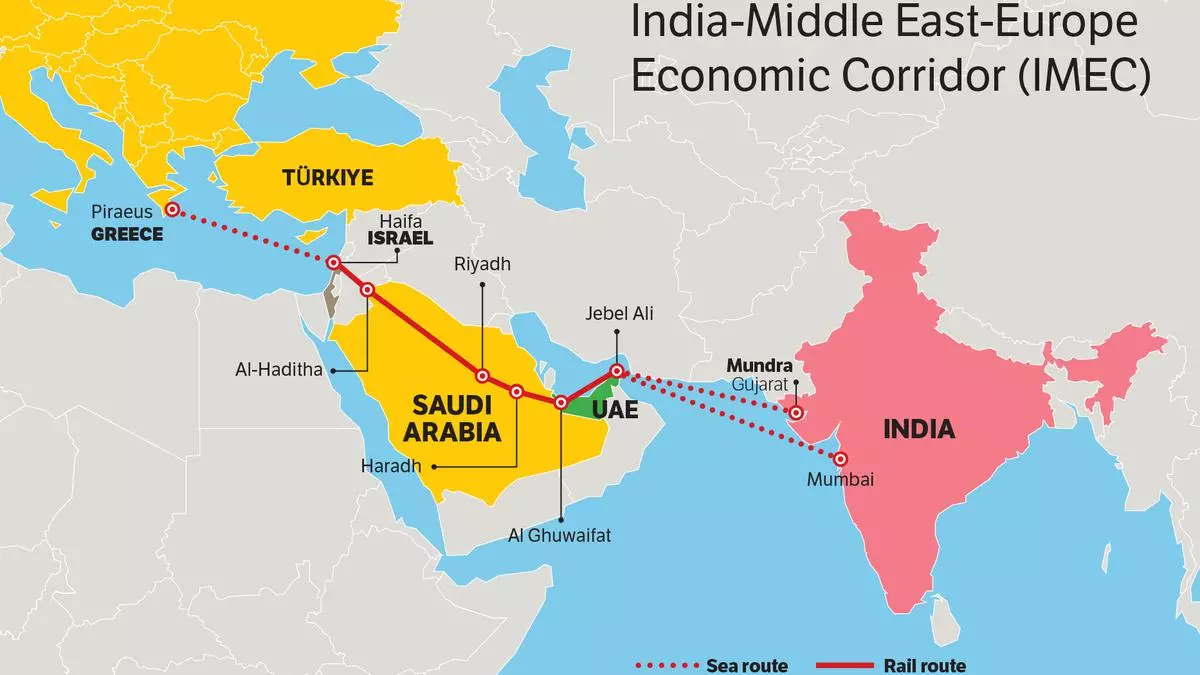
The India-Middle East-EU Economic Corridor (IMEC)

Pipe Dream or a Pathway to Shared Progress

By

Vice Admiral (Retd) Vijay Shankar (to be published)

Transcontinental Trade; from Shunya to Infinity

          At the heart of ancient Eurasia was India-a culture that exported its diverse civilisation, creating around it a vast intellectual domain. Vedic mathematics, technology, astronomy, art, religions, music, dance, literature and an irrefutable concept of the nature of creation and Man’s place in a dynamic universe; all put together pioneered a new outlook to the meaning of things. These revelations wove a path around the world through the medium of commerce and communications, which stretched across the Arabian Sea over land and sea to Greece and Rome in the west, to China in the north and to South East Asia in the east. The impact of India’s civilizational evolution stimulated innovation and growth. From the largest temple in the world at Angkor Vat to the Buddhism of China, from trade with Mesopotamia and Greece to the creation of the decimal system that we use today; particularly the sublime understanding of zero and infinity. India transformed the culture and technology of the ancient world (as reconfirmed by recent archaeological finds at Berenike) “…excavations make clear that it’s no longer possible to think of the trans-ocean trade as a ‘Roman’ endeavour. By the first century A.D. India was one of the main powers in these transcontinental trade routes.” -That was till a millennium ago.

Strategic Course of Geopolitics 

       Writing in 1890, Sir Halford Mackinder , suggested that the course of politics is the product of two sets of forces, “Impelling and Guiding. Impetus originates from a nation’s past, from historical stimuli embedded in a people’s character and tradition. The present, Guides politics by economic realities and geographical opportunities. Statesmen and diplomats succeed and fail pretty much as they recognise the irresistible power of these forces.” This discernment of geopolitics and the dynamics that influence it, is far more elegant than some of the more contemporary understandings led by Henry KissingerHans Morgenthau, Freidrich Ratzel and other advocates of Realpolitik. The latter suggested that geopolitics deals with power of a state and the will for domination; from this standpoint, lesser powers are condemned to the periphery. The governing doctrine was: national interests are best served through skilful manipulation by the State of the changing international balance of power. ‘National Interests’ in realpolitik is central and the art of the statesman is to strike equilibrium amongst competing interests through the instrument of power of the State.

          Clearly, while Mackinder saw the past as a force of stimulation; it was the critical reality of the present and its circumstances that became the prime mover of a nation’s role in geopolitics; Kissinger and his ilk saw “national interests” and the quest for balancing power as the motive force powering geopolitics. Absent was that it also became the catalyst of antagonism amongst nations. The latter perception, left the lesser powers to be mere ‘camp-followers’ with the corollary belief that geopolitics was about antagonistic ‘Blocs’ with irreconcilable differences seeking to dominate each other.

Genesis: IMEC the Multimodal Logistic, Energy & Digital Highway  

        An Intergovernmental Framework Memorandum of Understanding was signed on 10 September, 2023 during the ‘Group of 20 nations’ summit held in New Delhi for a multimodal infrastructural corridor that bound together nations with common equitable purpose. The Project was born of a need for a trusty corridor that did not owe its existence to the control of any one dominant Power. It is driven by three objectives: first, to provide strategic transportation arteries that connect to existing sovereign networks and in turn facilitate uninterruptible movement of global trade and commerce by land and sea. Second, to lay a grid and system of pipelines that facilitates free flow of energy (renewable, fossil and hydrogen). Third, to institute a digital-highway that links the participating nations to national webs for streaming of financial transactions, information and knowledge. What is unmistakable about the enterprise but remains undeclared is its underlying intent as an equitable, dependable and preferable option to China’s Belt and Road Initiative (BRI) and to provide an alternative to the Suez Canal.  The unique feature of the Corridor is the creation of a vast digital and energy highway in addition to arterial transportation freeways. The need and willingness to create an alternative to the extant and periodically troubled 195 Kilometre long Sea-Line of Communication running through the Suez Canal is a feature that harks back to the pre-First World War era.    

Lesson from History: The Ill Fated Baghdad Bahn  

        In 1903, a concession to construct a railroad was awarded by the Ottoman Sultan Abdul Hamid II (1876-1909) to Germany. The strategic Berlin-Baghdad Railroad was conceived, designed and financed by Germany to exploit Ottoman pan-Islamism in order to threaten logistic networks from British India and isolate their Colonial possessions. The rail line, planned to connect Berlin with the Ottoman cities of Konya and Baghdad with a new 1,600 kilometres track through modern-day Turkey, Syria and Iraq, from where the German vision to establish a port in the Persian Gulf bypassing the Suez Canal could be realised.                          

        The project was a manifestation of a dramatic growth of Kaiser’s economic clout. It played a role in the British-German trade rivalry, and in promoting hostility between the Entente and Central powers. Ironically the railway, on the one hand, helped unite the Entente powers against Germany; while on the other; led Germany into fear of encirclement and brought on World War I.  

        The scheme never fully fructified due British sponsored insurgencies in the vital Najd region of Saudi Arabia and technical glitches in the remote Taurus Mountains. Delays meant that by 1915 the railway was 480 kilometres short of completion, severely limiting its strategic utility during the war. The project failed on account of one critical consideration: the idea of strategic domination was not shared by the stake holders.            

        Is there a rude shock awaiting the IMEC? Is its timing so bedevilled that the enterprise may be consigned among the many lofty schemes that litter history, of well-meaning-but-star-crossed endeavours? Or can the project stand as a model for collaborative undertakings that disavow the impulse for domination?    

Uncertainties of the Times  

          A change has occurred. A world that was inclined towards global order driven by growth, interdependence and globalisation, has been replaced by a return of legacy tensions reminiscent of the “Cold War”, quest for military solutions, manipulation of governments into well-disposed pliable regimes; and, paradoxically, growing insularity amongst nations characterise the contemporary milieu.    

          Self-indulgent ‘National Interests’ are at crossroads; while Balance-of-Power advocates find themselves on a limb when faced with eschewal of individual sacrifice in favour of less disruptive sequestered alternatives. A reality well-arranged for over three decades through power and political manipulation is in the process of morphing into a mire of geo-political risks.

Cementing Partnerships & Mobilising Finances

           The Corridor is divided into three major segments India-UAE-Haifa-EU from where it links to the European Global Gateway Initiative (GGI); the aim of the GGI to open up the African continent complements that of the IMEC. The project envisions a two-part shipping and one overland route. Commerce from India would travel by sea to the United Arab Emirates (UAE), continue by rail/road through Saudi Arabia and Jordan to Israel’s Haifa port for onward shipment to destinations across the EU through links provided by the GGI. Bypassing the Suez Canal would substantially reduce time and cost.

Source: https://frontline.thehindu.com/world-affairs/how-the-india-middle-east-europe-economic-corridor-opens-up-a-passage-of-possibilities/article67344064.ece

Improved relations between India and the Gulf countries, particularly the UAE and Saudi Arabia as a progression of the Abraham Accords of 2020 and the consolidation of the I2U2 grouping has culminated in strategic partnerships. Shared interests have expanded beyond oil exports from the Gulf and remittances from the 9 million Indian expats; to include food security, fertilisers, renewable energy and the health sector. The signing of the Comprehensive Economic Partnership Agreement (CEPA) between India and the UAE in 2022 highlights this emerging mutuality. The initiative estimates that the IMEC could cut the time to send goods from India to Europe by 40% and slash transit costs by 30%. The IMEC will also expand digital connectivity on the Arabian Peninsula, and give Europe and India new sources for clean gas and will through the GGI extend the benefits of the corridor to Africa and to trans-Atlantic states.   

          Noting the IMEC’s potential, Saudi Arabia and the UAE are major advocates of the Corridor. The motivation is in part geographical; Saudi Arabia and the UAE form a natural territorial bridge between India and Europe and is in part financial. The Saudi Crown Prince Muhammad Bin Salman has already pledged to invest $20 billion in the initiative.  The IMEC also plans to establish a 20,000 kilometre cable system; the Trans Europe Asia System, to bolster under-sea and over land communication networks. This element of the Corridor is vital for improving the security of international data transmission.  

          The take-off, continuity, and flourishing of the IMEC are contingent upon several factors, the most critical of which is finance, de-risking and diversifying the project . Initial estimates suggest that the cost of each segment in the corridor can range anywhere between US$3 billion to US$8 billion. Securing the funding for this capital expenditure is a complex task as diverse participants are involved. Exploring effective and low-risk strategies for funding is important to attract private investments that are looking for stable risk-adjusted returns. However, the IMEC can lean upon the G7’s June 2023 commitment to mobilise US$600 billion in funding from private and public sources over five years. This initiative seeks to finance infrastructure development in emerging economies, serving as a strategic counter to the BRI. Furthermore, the ambitions of the IMEC to enhance the logistics of hydrogen energy are congruent with the strategic priorities of both the US and the EU, focusing on transitioning Europe’s energy reliance away from Russian fossil energy to clean eco-friendly sources.   

          Notwithstanding the prospective financial pledges, the introduction of Innovative Financing Instruments (IFI) will add to stability of investments and expenditure for the Project. IFIs may include the following five:

  •  Performance Contracting through State guarantees of future savings.
  •  Green Bonds that assure environmental benefits that may be monetised.
  •  Governmental level equity and, hybrid financing.
  •  Financing by linkages to geopolitical concerns such as security anxieties caused by ‘Grey Zone’ disruptions.
  •  Sum and Substance of the project may be summarised by the quintile policy: Productivity-People-Profits-Protection-Planet.   

          The IMEC thus seeks to create a comprehensive infrastructure network connecting countries with a combined GDP of US$47 trillion, encompassing shipping lanes, railways, roads, undersea cables, energy pipeline networks and solar grids. This initiative holds great potential to bolster global trade efficiency and ensure energy security. However, significant challenges exist. Building such a vast network requires overcoming political, financial and security hurdles. Regional conflicts and differing priorities create a complex and unsettled landscape. Additionally, competition with China’s BRI adds to insecurity as it may provoke inimical activities in the ‘Grey Zone’.

Political Risks Staring Down the IMEC

        Two on-going wars, the assault on global supply chains, disruption of existing financial order, teetering of world-wide security structures, and the looming emergence of a revisionary and “rejuvenated” China; are all settings of contemporary geo-politics.

Global supply chains have been relentlessly breached by the wars in Ukraine and Gaza. Prior to the war in Ukraine, projections estimated global economic growth to be around 5%. The war, however, turned post- pandemic optimism to a “crippling economic shock”. A  November 2022 report by the Organisation of Economic Cooperation & Development (OECD) suggested that it was the main factor that had slowed global economic growth to 2.2% in 2023. The conflict, the report added, had the greatest impact on Europe’s economy; where growth in 2023 was just 0.4% and in 2024 was 0.9%.

        As a direct fall-out of the conflict in Gaza, drone strikes are being launched indiscriminately by rebel Houthis out of South Yemen targeting maritime traffic transiting the Straits of Bab-El Mandeb. The Straits and the Suez Canal are effectively shut to merchant traffic. As animmediate alternative, a ‘Land Corridor’ has been established to transport cargo off-loaded by sea at the UAE then transiting by road and rail across Saudi Arabia to Jordan, and terminating at Haifa in Israel. Use of the route was launched in late 2023. It provides a stand-in, albeit costlier, very limited and slower passageway that avoids the severely disrupted Red Sea route. Referred to as the ‘Land Connectivity by Trucks’ project, the America-backed corridor enables movement of containerised freight that cuts voyage time and cost around the Cape of Good Hope.  

        The long-term viability of the ‘Land Bridge’ depends both on regional stability and iron-clad endorsement from countries hosting sections of the route. Container transporters such as M/S Hapag-Lloyd, stated that the corridor could serve only as a short-term solution to sustain trade flow from ports which “would otherwise be cut off from their normal links to the global economy”. The questions that arise are: is the corridor sustainable? How stable is the region? At what cost and for how long can it be kept alive? What becomes of the cargo standing in queue?

Financial Order

        Policy thinking on global financial order has, in the main, been shaped by whether one is a provider or a beneficiary and whether the beneficiary government is pliable. Since the end of the Second World War, the US centric bloc, both directly and indirectly, has held great influence over the rules and norms by which global finance is governed. However, the rise of China and other powers, the diminishing financial clout of the USA and a global retreat from free trade suggest that America may not have either the means or the remit to deal with global crises as effectively as it once did.  

        A globalised world will have to move beyond a zero sum transactional state if ‘universal prosperity’ is the purpose. The implication is: nations would by law avoid policies that have an adverse effect on countries from events instigated in another state or region. Events include man-made disasters, political crises, conflicts and wars. While it may be unrealistic to expect such “virtue-in-policy”, it remains the only way of managing risks threatening global financial stability.

        IMEC is a complex project and has to be insulated against economic shocks and financial instability that lead to interventions of a nature (conflicts, sanctions and unfair trade practices) that could stifle a global enterprise such as it is.   

Security Order in a Disquieting “Grey-Zone”

        In the past it was the size of a nation, imperious resolve and access to resources that determined its wealth, power and control, particularly so in a closed mercantilist world economy as existed a century ago. In contemporary times the determinants may have changed but at its core it remains (with some exceptions) the same. Despite the importance of economics and diplomacy in the power of a state, traditional military might has not lost sway as the primary consideration of geopolitical heft. It is equally clear that interdependence and globalisation have failed to usher in the mythical future of soft power dominance. Instead, globalisation, as contemporary scenarios indicate, is held ransom by unbridled hard power. To believe otherwise is to succumb to a delusion in which resources are infinite, the quest for power dominance non-existent, warfare in the ‘Grey-Zone’ a fib and rogue states can be trusted to act honourably. ‘Soft’ interdependence has merely added to the list of vulnerabilities for the application of coercive power.

        The ‘Grey-Zone’ describes a set of activities that occur between peace and armed conflict. A multitude of actions fall into this penumbric zone. They include clandestine disruptive economic activities, influence operations, cyber-attacks, mercenary operations and disinformation campaigns. Generally, grey-zone activities are instigated and executed by state actors, non-state actors, fifth columnists or those that abet them; they employ a combination of non-military and quasi-military tools that fall below the threshold of armed conflict. Aim being to thwart, destabilize, attack or persuade an adversary; they are invariably tailored towards the vulnerabilities of the target state.

        Prime Minister Modi, in a meeting with President Putin on 15 September 2022 at the Shanghai Cooperation Organisation suggested that “this was not an era for war”. That pithy statement may have many interpretations, however, when viewed in the context of his now oft quoted concept of Vasudhaiva Kutumbkam , what may also be inferred is: rather than war and conquest promising an avenue for wealth, it is equitable and secure economic activity that is a more profitable path to economic well-being. Conquest, today, is an uncertain and risky endeavour, as the many wars of the 20th century have underscored.    

Redefining Security

        From this, a new definition of security emerges. National security has moved out of the restraining cocoon of just “defence of sovereignty of the State, its people and institutions”; to a far more nuanced perception that factors growth and development of the State along with the well-being and freedom of its people. And, critically, shielding the State from the impact of hostile Grey-Zone activities, intended to destabilise or strike at the vulnerabilities of the State. It is not as if the grey-zone was not exploited in the past but globalisation, interdependency and proliferation of technologies have made its impact far more severe a disrupter of systems and governments.   

         While there could be several snags to the Project intrinsic to the region, the principal impediments emanate from Beijing, not just because it perceives that “China is at the centre of the West’s war plans” (The hundred Year Marathon, Pillsbury), but because China contests alternatives to the BRI, claims ‘exceptionalism’ and more importantly because the IMEC poses a threat to China’s revisionary dream of a global order on its terms. Our examination will now focus on how the BRI has been weaponised, Beijing’s quest for exceptionalism and its promise of retribution for the “Century of Humiliation”.  

Weaponising the BRI

        The BRI represents a grand strategy conceived to promote a sense of Beijing’s distinctiveness through economic power; which it perceives as means to bring about political alignment of member countries (151) with China’s interests in order to       re-orient the world economy and dependency towards China. Marketing of Beijing’s worldview is concomitant to the operation of Chinese soft power in a setting where the line between hard and soft is indistinct. In this context to employ economic means to subvert pliant dispensations and set “debt traps” is par-for-the-course. In the first ten years (2013-23) since launch of the BRI, China has invested or at least pledged $1trillion, some of which is on exclusive loan from the People’s Bank of China. Over 90% of the loans are to capital starved member countries from the lower income group that have questionable resources to pay back.

        In Pakistan, the China-Pakistan-Economic-Corridor (CPEC) a ‘flag-ship’ part of the BRI infrastructure, loans came on seemingly favourable terms that ruled out competing lenders. Today, the state of the CPEC has had disastrous impact on the economy of that nation to the extent Pakistan minister for Planning has called for  dissolution of the authority in control. Notwithstanding, Beijing views the project not in terms of economic benefit to the host nation, but as a strategic energy corridor to soothe their Malacca Dilemma, since the bulk of China’s insatiable energy demands and 90% of their trade transits through the Straits.

        And so, China’s BRI is not just an instrument of economic heft, but a cudgel that has led to crippling indebtedness of 24 African nations  of which five are significant as their debt is over 30% of government revenue; these include Angola, Ethiopia, Egypt, Nigeria and Kenya. While in Asia; Pakistan, Bangla-desh, Sri-Lanka and Myanmar find themselves in circumstances that has forced them to cede concessions in terms of infrastructure, territory and indeed polity. From China’s perspective, investments and possession of strategic locations help diversify China’s logistic network for critical resources. In effect the BRI has been weaponised.    

Chinese Exceptionalism: To be Good & Great

        The dazzling rise of China was fuelled by a misshapen American policy enshrined in the Shanghai Communiqué 1972. The much brandished purpose of this agreement was to upend the Sino-Soviet alliance in the Cold War. The underlying belief was that the recognition of ‘One-China’ and the provision of massive economic, military, science and technology support would irreparably fracture the overwrought Sino-Soviet relations and bring Beijing into the ‘liberal’ western world order. China on its part used and overturned this belief through deception, emulation and exploitation. Since then, not only have China and Russia set aside their differences of the 1960s; but have become more assertive internationally and far more unpredictable. China the more dominant of the two, today stands on the cusp of challenging the acknowledged global hegemon.           

        The growth of China has been accompanied by ‘self-attributed’ virtues of being both “Good” and “Great”. By emphasising these abstract features it seeks to provide Beijing the right to ‘exceptionalism’ in its choice to chart a unique course on the geopolitical map. The manifestations are clear as defined by claims of ‘Rejuvenation’ that would not only bestow justice to Beijing for its ‘century of humiliation’, but also enable a revisionary approach to global governance. China suggests that by comparison, the existing hegemon has an offensive militaristic face intent on control of global economic systems and unquestioned predominance over geopolitical influence. Beijing’s brand of exceptionalism purports to be, more friendly, defensive and benevolent. The problem really is will global audiences concede the value of Beijing’s political norms? And whether the Chinese approach to use its perceived civilizational experience (great as it may be) for defining an alternative global order, finds legitimacy amongst the comity of nations?         

Means: The Thirty Six Stratagems

        The “Thirty-Six Stratagems” is a Chinese collation of maxims that outline artifices for use in politics, war, and civil relations. Its focus is on beguiling an adversary. Compiled as a corpus of proverbs during the Ming era in China (1368-1644); the aphorisms are bereft of scruples and provide a template for success through ruthlessness, subterfuge and an antiquated sense of civilizational order.  

        Many of the ‘thirty-six’ are disquieting in their significance. Take for example the following: “kill with borrowed knife”; “loot a burning house” or even “hide a knife behind a smile”; suggest treachery in dealings. While others such as “befriend a distant state and strike a neighbouring one”; “replace the beams with rotten timbers”; “feign madness but keep your balance”; “remove the ladder when the enemy has ascended to the roof” all ring a note of chicanery in international relations.   

        The society that Beijing has moulded is collectivist in character; wherein the Party is morally, politically and economically the master of the individual and therefore the sway of the ‘Thirty Six’. This is not hard to understand given the CCP’s abstract views on national prestige, interests and the ability to differentiate between the State and its citizenry that accommodates the existence of a chasm between elitist constructs of domination and the reality of trials that the citizen may face. Collectivism promotes the idea that the individual is an appendage of a larger and more critical entity, the CCP.  The ‘Stratagems’ may advocate an archaic text for villainy; but what is disturbing is that Beijing has employed several of the ‘thirty-six’ in their international transactions with “friends” and adversaries alike. Conventional wisdom suggests clichés from old patterns of warfare are out of harmony with modern perspectives on conflict. And yet paradoxically, Beijing persists with their usage. In the run-up to the Sino-Indian war, they lulled PM Nehru into believing that their relationship was fraternal before they invaded in 1962; during the cold-war they manipulated the Americans and the Soviets, as tools for their own advancement and global ambitions. After the USSR collapsed, they deceived the USA that partnership with them was to their mutual benefit, till they attained adequate power today to contest them. On the commercial front they have ensnared nations in debt traps through their brand of predatory economics.  

Nudging the South China Sea to the Brink 

        In the South China Sea (SCS), Beijing’s aggressiveness has resulted in heightened tensions with all the littorals, particularly Japan, Vietnam and the Philippines. Their sweeping claims of sovereignty over the SCS within its contrived ‘Nine-Dash-Line’ and arrogating rights to the sea’s estimated reserves of 11 billion barrels of untapped oil and 190 trillion cubic feet of natural gas have antagonized legitimate claimants Brunei, Indonesia, Malaysia, the Philippines, Taiwan, and Vietnam; who under the UN Convention of the Law of the Sea (UNCLOS), not only have freedom of navigation, but also the license to exploit their EEZs. In July 2016, the Permanent Court of Arbitration at The Hague ruled in favour of the Philippines, rubbishing the Nine Dash Line entitlement. China, however, despite having ratified the UNCLOS; rejects the Court’s authority.   

        In recent years, imagery has exposed China’s efforts to reclaim land in the SCS and even creating artificial ones. It has constructed ports, military installations, and airstrips—particularly in the Paracel and Spratly Islands. In the Woody Island it has deployed fighter jets, cruise missiles, and surveillance systems. Beijing’s claim to the SCS portends control over commerce and energy flow; an eventuality intolerable to not just the littorals, but to the world. To protect their interests in the region, nations have challenged China’s aggressive territorial claims and land reclamation policies. Amid rising tensions, claims, bullying, hindering legitimate economic activities and establishing unlawful Air Defence Identification Zones; there is a rapid military build-up in the region that has pushed the Indo-Pacific closer to the brink.  

Nature of Potential Conflict

        Three features of Beijing’s revisionary aspirations are potentially in conflict with the IMEC. As mentioned earlier these are: China’s quest for exceptionalism; weaponising of the BRI and aggressive militarism in the SCS. Exceptionalism pressures a posture that places the claimant above laws, conventions and agreements; it is backed by power and a willingness to undermine any resistance to its order of things. Beijing repudiates alternatives to its perspective through means that play out in the ‘Grey-Zone’ and counts on its exceptionalism to make legal their domestic and international politics. For, legitimacy confers on the CCP the exclusive right to enforce policy both internally and externally. However, centralized control also places sole responsibility on leadership when outcomes digress from rhetoric. Legitimacy is the CCP’s “Centre of Gravity”; mismanagement of narratives and a failure to sustain prosperity coupled with simmering discontent, as witnessed during the Zero-COVID policy, will strike at their Centre of gravity and severely impact the Party and its vision of exceptionalism.  

Riposte to the Challenge Posed by China

        The most substantial vulnerability is the CCP’s legitimacy and its inconsistent narrative, particularly on the international stage. Idealistic phrases like ‘harmony, peaceful coexistence and non-interference with Chinese characteristics’ employed by the Party to portray China as a benevolent power, stand in stark contrast to the reality of their predatory economic practises and usurping of sovereign territories. Beijing’s actions in the SCS provide a glaring example of simultaneously professing adherence to international law while deliberately subverting it.  

        The second vulnerability is Beijing’s ideology which perceives international laws, conventions and protocols to be no more than contrivances for consolidating power and justifying its arbitrary use. The masses are often willing to endure repressive control if their living standards remain reasonable, especially when those standards continue to rise, as has been the case in recent years. As noted in the context of China being ‘good, great and exceptional,’ once a pattern of upward mobility becomes the norm, economic growth is expected. Susceptibilities arise when growth declines or encounters setbacks. Moreover, inconsistencies in ideology serve to undermine it. In the CCP, clear class distinctions between the affluence of the Party and the proletariat are a contradiction that cannot be bridged and in times of crises neither will the proscription of the individual in favour of the Party be tolerated beyond a limit. Such discrepancies erode the foundations of control and when coupled with simmering discontent, as witnessed during the Zero-COVID policy protests, can fracture the nation.

        Beijing understands power and how to leverage it. The CCP’s natural fear lies in the fact that nations recognise its ambitions for what it is; of revisionism and exceptionalism. So measures taken to show willingness to face up to the challenge of Beijing through groupings that provide alternatives, such as the IMEC, will give pause to temper their bellicose approach to the abuse of either economic or military muscle.

The Strength of Banding Connectivity

        In the conviction that the world is facing an existential threat from China, the lone hegemon has brought together a consortium of nations that are opposed to the idea of a revisionary disruption to the current global order. Thus far several groupings such as the QUAD and the AUKUS, are in place to contend with the strategic posture adopted by China. While there intent may appear reminiscent of the policy of ‘Containment’ from the Cold War era, they must be perceived as “what they signify and add up to, rather than who they oppose”. 

        At the strategic level, the IMEC aims for a vast region of the world to band closer together through economic connectivity and partnerships. Simultaneously, the corridor would provide a boost to India and the region’s strategy for growth. The UAE and Saudi Arabia embrace IMEC as part of their push to become an economic bridge between East and West. The EU stands to gain from this enterprise to wean itself away from dependence on China and re-engage with the nations of the African continent. While the world at large will benefit from a more efficient and less vulnerable trade, energy and digital corridor than the Suez.  For the IMEC to fulfil its potential, the participants will need to coalesce around implementation plans that can reconcile the Projects many goals. They will also need to overcome internal and external obstacles to the corridor.

Conclusion

        Historically, growth and prosperity were linked to a distinctive military culture that stressed on discipline, mercenary practices and exploitation. Particularly so, when conquest fetched territory, resources and colonies. The problem in the modern era with such a notion is that the same beliefs usher destruction, loot and strife; leaving protagonists exhausted and bereft of a blueprint for either reconciliation or growth. On the contrary, they are left with a legacy of unresolved conflicts. Wars of the 20th and now the 21st centuries stand in mute testimony to this.

        The failure of the Berlin-Baghdad Rail link has been attributed to many reasons these include confrontational politics of that time, poor management and technological challenges. However most significant was the weaponising of what was intended to be a transnational infrastructural project and the design to mix economics with domination. 

        At the heart of realising success in the IMEC project is neither military power nor control nor even domination; but of advancement of a political ethos that harmonises the needs of the many collaborators and assurance of equitability and security. Underpinning precept is that ‘more the stakeholders, more the thrust for stability. To put it succinctly: “Productivity-People-Profits-Protection-Planet”.

Unfortunately strategic planners rarely occupy themselves with the higher problems of growth and international relations; rather, are content with the narrow outcome of either fulfilment of a political directive; attainment of a tactical goal or even realisation of a self-seeking purpose, blind to the validity that success is a function of sculpting a holistic strategy that elevates various instruments of power alongside traditional military deterrence.    

‘Strategic Competition’ is War by Other Means

A Troubling Legacy of the Westphalian System

By

Vice Admiral (retd) Vijay Shankar (to be published)

A debate rages amongst western scholars and strategists of the significance and what elements of statecraft make for the essence of “Strategic Competition”. The argument is centrally about influence over the international system.

The phrase “Strategic Competitiveness” first made its appearance as a polcy touchstone, notably, in the 2018 National Defence Strategy of the USA. The document identified the revisionist states of China and Russia as strategic competitors. China for using “predatory economics” to intimidate lesser endowed nations while militarizing and persisting with its illegal claims in the South China Sea; and Russia as an “autocratic nationalistic state that eschewed the economic, diplomatic, and security aspirations of its erstwhile bloc”. The document further envisages challenges in every arena of human endeavour and the only answer it presents is to “field a lethal, resilient and rapidly adapting Joint Force. The Joint Force is combined with a robust constellation of allies and partners…aim being to achieve favourable balances of power that safeguard the free and open international order”.  

This understanding of the policy has indeterminate strategic significance, rather cramped relevance and harps on a chord reminiscent of the cold war in its quest for ‘Balance of Power’ and the carving out of two adversarial military Blocs. In a sense it entails substantial economic, political and military risks not just to the protagonists but to the world at large; and significantly excludes nations who may choose not to accept a confrontational posture or retain strategic autonomy.  

The Westphalian Paradox

The Peace of Westphalia, signed in 1648, ended long drawn out wars between feuding Christian societies in Europe. Its purpose was to consolidate a teetering Holy Roman (German) Empire that had been ravaged by wars, fragmentation and economic depredation. It created the “framework for relations” within West-Central Europe. Concepts of state sovereignty, new to Europe, and diplomacy find mention in the text of this Treaty.

While it was one of the attempts at codifying relations between states through an accepted set of laws, there was a looming threat that it provided a shield against. For, not only did it provide a basis to hold together Christendom as existed in West-Central Europe, but was an elemental collective pledge to confront the Ottoman Empire which was rampaging to its peak of power, wealth and expansion in South East Europe. What the Ottoman began as conquests in Asia Minor, led to the annexation of vast territories in Bulgaria, Greece and much of the Byzantine Empire. With the fall of Constantinople during the reign of Mehmed II (1432-1481), the Sultan’s dominion extended well into central Europe and was an ominous portent to the ‘Holy Roman Empire’.

Historical facts remind us that through the ages no International Order has ever been absolute nor has any one hegemon been endowed with the necessary power to control an Order in perpetuity. The emergence of rising powers provides the necessary dynamics for transformation of International Order; which in a way, mistakenly, provokes the mind to accept the simplistic axiom that “wars occur when the established order is challenged”.

The lamentable paradox is that the Westphalian System still remains the model for international relations, politics, concept of state sovereignty, basis of treaties/conventions and, critically, sets the criterion for “Global Governance”. This despite the arrangement not having space for emerging powers of autonomous bent. Just how pernicious the system can be was captured in  President George W. Bush’s confounding declaration to a joint session of Congress on 20 September 2001 where he left the comity of nations with a Hobson’s choice, “…Every nation, in every region, now has a decision to make, either you are with us, or you are with the terrorists.”

Contrarian states are recast as a threat to order; this crudely was the essence of the system. Competing powers within the fetters of the Westphalian Model are projected to be disruptive entities that seek to topple the balance of power and rebuff the institutions that are at the heart of Global Order extant. The system ironically was conceived to provide a security arrangement specifically for the Christian principalities of Germany (of the 17th century) while keeping some form of cohesiveness amongst believers of the faith within the ‘Holy Roman Empire’, significantly to serve as a bulwark against the rampaging Ottoman Empire to the South East. Its applicability was constrained by geography, race, identity, ethnicity and critically belief; its purpose was specific for Hapsburg control (1438-1740). Indeed, as a professor of military history at the National Defence Academy asserted …in this realm, command was neither “Holy nor Roman and not even was it an Empire!”   

The Post-Cold War Order

Global Governance is a post-Cold War concept (1995). Recognizing the new climate in international relations, former West German Chancellor Willy Brandt, in 1989, brought together a group of international leaders to explore new approaches to managing global relations.  His efforts laid the foundations for the establishment of an overdue Commission on Global Governance. Indeed the inabilities of the Westphalian Model can be seen in various modern international institutions including the United Nations which is a leading example of how civilizational experiences of diverse societies that make up the international milieu of the day are excluded. The UN in addition to its many spectacular failures —often as a result of indecision but more on account of its weaknesses is a case study in what ‘Global Governance’ ought not to be. There are neither binding rules to forge agreements nor can the power of veto be reined-in through the intellectual science of reasoning. What carries the day is which side is backed by brute power. As in the war in Syria; when agreement falls prey to selfish interests; or in Rwanda, where the genocide of 1994 is yet to find closure. Selectively applied international norms that suit privileged interests, is another agent, as in Iraq and in the Russia – Ukraine conflict; or more perilously due to finance driven bigotry, as during the recent Covid 19 pandemic. In all cases the very purpose of the UN to maintain peace and security, uphold human rights, provide humanitarian aid and put in place a model for sustainable development amounts to little else than empty talk, bereft of value and at times, an instrument to justify malfeasance.

Recognising the weaknesses of the Westphalian Model the Commission suggested the creation of “a multilateral regulatory system of management focussed on development of global independencies and sustainable development”. The idea has in its original form lost traction over time and wobbles on the edge of history’s garbage pail. Was this an act of geopolitical short sightedness or self-centredness of Western elites and influencers or was it a deliberate act that saw in the post-Westphalian world the need to cement a place for the Global Hegemon?    

The Focus; Sway over International Systems

The method of conducting international relations and the institutions that enabled the creation of alignments are pre-disposed to the idea of Realpolitik and are, consequently, interpreted in terms of the national interests of the resident hegemon. The coming of an emerging power, accordingly, sends out the call for an impending confrontation. One of three possible fallouts of such interplay is; assimilation into the Order, defeat by force of arms or advent of a new Order.

International benchmarks for accomplishment in Strategic Competition are five-fold: vitality of citizenry, technological prowess, strength of economy, demography and geographic endowment. These characteristics form the basis for determining two critical competitive priorities:  degree to which rivalry can be advanced and at what stage rivalry turns to “unfavourable-antagonism”, both priorities are driven by blinkered national interest, defy common understanding and border on brinkmanship. Since the struggle is, in many ways, over the essential character of the international system its institutions, rules and conventions; it is the individual perception of ‘universal application’ that prevails over the narrative. Morality, in the matter, plays a minor part. The key lies in how the anecdotal can be reconstituted to present a convenient reality. Indeed, it will also explain the power exertions that dominate this pursuit.  

The dangerous dichotomy lies in the divergent pulls that exist between a globalised world economy and exclusive state polity. While the world economy relies on a secure and stable system of governance for trade, communications and development for which organisations exist on land and in the air controlled and regulated by United Nations institutions such as the International Chamber of Commerce, the International Civil Aviation Organisation, the World Trade Organisation; and on the oceans it is built on the bedrock of the UN Convention on the Law of the Sea (UNCLOS). UNCLOS lays out rules for everything from global shipping enterprise and management of offshore natural resources including fisheries, critical minerals, oil, and natural gas—all managed primarily through the convention’s authority. Yet, Strategic Competition is not about how best these institutions can collectively be governed; but about control of these very institutions.      

Outcome of Competition: Collapse, Capitulation or Compromise

Studies refer to the concept of strategic competition over a range of interpretations; from a tautological point of view as “the act of competing” to the more nuanced “attempt to gain advantage over a nation or group of nations that are believed to pose a threat through self-interested pursuit of power and influence.” Two phrases in the latter description that become significant are:  ‘…believed to pose a threat’ and ‘…pursuit of power and influence’, both of which remain open ended in their implication and substance. While the issue of what comprises a ubiquitous threat and what commonly is recognised as the object of power and influence remains masked. Indeed, for a nation to announce that it is embracing Strategic Competition says nothing about how it will do so—that is, what specific instruments of state power to achieve success it will employ—or what it will prioritize. 

A realistic scrutiny of the relationships involved conforms to the historical concept of ‘Great Power Rivalry’, which in the past determined foreign policy, economic rapacity and national security; all characteristics that underpinned domination. The question that begs an answer is ‘in what way does Strategic Competition differ from Belligerent Hegemony?’  If the former refers to the combination of one group of people or groups of people exploited by another group of people; then there is little difference. The process of competition is invariably a tussle of differentials in growth rates, technological prowess, ideology distinction and economic stability; which in turn impacts on political and ominously, military balance.

Our own experience of competitive rivalries since the age of colonial antagonism to the present, tend to ignore the critical question of outcomes as planners fail to occupy themselves with where ‘Competition’ is leading to. History of intense rivalries between nations, tell us, they end for one side, in one of three ways: Collapse, Capitulation, or Compromise. Outcomes that terminate in consequences other than these three often set the stage for a return to confrontation.

We are then faced with a strategic dilemma which Michael Howard (war and social change-an essay) underscored, “…there is no war without resistance; but without resistance and the possibility of resistance, there is no International Order.”

Strategic Competition in Ukraine; Hazards of Wavering Resolve

The downside of being a part of a group engaged in strategic competition is the danger of rapid escalation and ‘wavering-resolve’. The on-going conflict in Ukraine is an example of how rapidly the situation can escalate to armed conflict and how diffidence can queer the pitch when engaged in strategic competition. Jens Stoltenberg, the ‘On-Off’ NATO Secretary General, suggested Ukraine might today have to decide on some “kind of compromises”. The former Commander of the UK’s Joint Forces Command went a step further when he warned that Ukraine could face defeat by Russia in 2024. General Barrons is quoted as saying “there is a serious risk” of Ukraine losing the war this year. The reason, he attributes, is “because Ukraine may come to feel it can’t win”. “And when it gets to that point, why will people want to fight and die any longer, just to defend the indefensible?”

Why people will want to fight and die is very convincing logic, but to have reached this conclusion in a proxy war after two years of so much disruption, wasteful destruction and sapping of global economies is baffling, to say the least.   

Enervating Frailties and the Virtue of Biding One’s Time 

While the agitation continues with academics and think-tanks over whether there exists a red-line between ‘Competition’ and ‘Conflict’; China has embarked on its own discernment since the 1970s, of ‘What is’ and ‘How’ Strategic Competition is to be prosecuted. At its heart are two pivotal precepts: the first is that the accumulation of power, beyond a point, can turn on itself; for the essence of competitiveness is to recognise that ‘Power’ plays a covering role as a bulwark against precipitate recourse to arms. Targeting frailties of the adversarial system and measures taken to enervate them (over time) through the manipulation of information and undermining values; till decay and doubt sets in is the aim. Beijing believes they can wait. The second is to guard against reckless acts by the adversary that may compromise China’s festering debilities and, indeed, undermine their scheme of enervating the adversary. Not having put a time frame for their strategic plans has lent considerable credibility to China’s position as a major power. Going back over the last half century, it is apparent that Beijing has persisted with this policy of playing one superpower against the other and yet, often, acted in defiance of the two. Despite its vulnerabilities, it neither yielded nor has it been pliant to the entreaties of Moscow or Washington. For these very reasons and as a participant in the many political and military conflicts of the post-cold war era China has today attained a singular stature in the international system as a superpower.

As China’s power grows and the contours of its Grand Strategy of ‘Rejuvenation and Revision’ are fully unveiled, the four ‘Initiatives’ or instruments of its strategy can be seen from a perspective that is set on competing and overturning existing order:

  • The first is the Belt and Road Initiative (BRI) that poses to finance and boost infrastructure of dependent and client economies and in turn become the engine of Beijing’s geo-strategic military, financial reach and political clout.
  • Second, the Global Development Initiative (GDI) launched in 2021 at the UN General Assembly targets developing nations with small-scale projects that address poverty alleviation, digital connectivity, climate change, and health and food security; aim being to further their hold and reliance on Beijing. At its core is Beijing’s emphasis on economic development as the basis for human rights rather than equality and dignity.
  • Third, the Global Security Initiative (GSI), launched in 2022 seeks to promote China as the central arbiter to coordinate security needs of the region first, followed by global demands, through diplomacy contingent upon China.
  • Lastly, the Global Civilizational Initiative (GCI) introduced in March 2023, promotes a state-focused and state-defined values system that serves to eliminate universal values such as human rights and democracy. In a GCI-related address, Xi called “peace, development, equity, justice, democracy and freedom” “common aspirations”, and not rights, of humanity. The GCI argues that the perceptions of such “common” aspirations are “relative” and that countries must “refrain from imposing their own values on others.

Meanwhile globally nations in the West and Asia are determined to push back against what is seen as Chinese hegemonic designs and revisionism. Multilateralism in this milieu provides a tremendous advantage, particularly so when strategic interests converge when confronted with a Beijing that seeks ‘Rejuvenation’.

Beijing has emerged and has thrown the gauntlet to unsettle the existing status-quo. In strategic terms the greatest risks in the competition are that contestants develop policies and technologies that threaten existing critical economic networks and informational dependencies within the prevailing international structures. This provides the logic for preparations by the military to fight an indefinable and often elusory conflict through the formation of coalitions and arming to the teeth. Who then benefits from Strategic Competition?

The Indispensible Enemy

               Daniel Ellsberg, the late, well acclaimed whistle-blowing author of the Pentagon Papers, posed a query: ” In the current state of world affairs where, uncertainty and conflicts are the rule; who benefitted from war?” Certainly in Ukraine, the South China Sea and Gaza it cannot be the chief protagonists but the contrivers and puppeteers of conflict.

The proxy war in Ukraine benefits most the USA; for the conflict has turned back to history and revived a threat from an “alliance of authoritarian powers” working against Western democracies. It has paved the way for American growth and leadership, and fashioned an antagonistic bloc comprising Russia, China, Iran and North Korea. And so too potentially, has the brewing conflict in the South China Sea; the conflict in Gaza is complex for it has gone beyond retribution.

Israel’s war against Hamas may have been justified by the latter’s murderous assault of 07 October 2023, but for the battering of Gaza to be prosecuted with a perverse and unrelenting ferocity for over ten months begs an explanation that cannot be vindicated by the idea of ‘rightful-reprisal’. Indeed, is there more to this conflict? Could it be that carnage provides the opportunity to take the first step towards realising the long sought after alternative to the bothersome absence of control over the Suez Canal? The Ben Gurion Canal project proposes to connect the Gulf of Aqaba (Eilat) in the Red Sea with the Mediterranean Sea and would pass through Israel and end in or near the Gaza Strip (Ashkelon). And if this Canal became a reality the Suez moves to the background for it can handle deeper draught and greater volumes of traffic. Most critically the Canal would be under firm control of the USA, Israel and the Western powers.

The key to continuing Great Power status, as Ellsberg ominously suggested, was the incessant availability of an indispensible enemy and the will to competition with that foe.

Global Governance and the Quest for a Stable World Order

The ‘Authoritarian Bloc’ is in a perilous struggle to bring about the decline and collapse of its perceived rivals with the aim to don the mantle of world leadership. In such a calculus, international affairs of the day, presents a world in which it is not just the ‘balance of power’ that is sought to be toppled; but every element of society—economy, diplomacy, law, trade, cyberspace, social media, journalism, culture and indeed the very nature of peoples—have become tools in a strategic competition. States with political authority over the sources of power of a nation are uniquely positioned to impose costs on other states. They have the advantage, in the short term, since they can wield elements of ‘soft and hard power’ unquestioned and direct through central control of these instruments. This state of affairs can only last as long as citizens remain convinced of motivations and kept blind to hazards of such competition.

With proliferation of nuclear weapons and the growing inclination towards the use of low-yield weapons to salvage a troubled conventional campaign; balance of power has ceased to be a fully relevant and credible principle of global order. However, it still retains a presence in international relations, more particularly, in the sphere of regional relations among states. So it is neither balance of power nor the exercise of brute force or even the emergence of a global hegemon that will assure a stable world order. Global governance in its pristine form is order that emerges from institutions that recognise the equality of humankind, acknowledged processes, formal agreements, and informal time-honoured mechanisms that negate unilateral military action and regulates collective action for a common good.

Global governance encompasses activity at the international, transnational, and regional levels that transcend national boundaries. In this conception of global governance, cooperative action based on rights and rules that are enforced through a combination of financial and moral incentives and, should the need arise; collective military power that proposes to replace disruptive strategic competition. If not, as Willy Brandt in 1980 put it, “Are we to leave our successors a scorched planet, impoverished landscapes and ailing environment?”