The Road to a Not So Harmonious Rise

By

Vice Admiral (retd) Vijay Shankar (published in the IPCS web journal in my column “The Strategist and may be accessed at the following link: http://www.ipcs.org/comm_select.php?articleNo=5855)

 The Dream

When Xi Jinping took office in March 2013, he was “elected” President in a confirmation vote by the People’s Congress in Beijing; he received 2,952 votes in favour and one against. Replacing Hu Jintao, who retired after serving his two terms; tenure legislated to annul the possibility of the Mao-kind-of-excesses.

Most nations felt Xi’s “ascension” represented more continuity, persistence with tenure-based leadership, more liberal reforms and a closer draw into a globalised world. China’s declared goal was to achieve “Harmonious Rise”. But there was a dream for Rejuvenation and  of China’s Centrality. Much of the world dismissed this as rhetoric from the nationalistic fringe. But to Xi, his predecessors and the Party; Rejuvenation and Centrality were obsessions that had endured the mass carnage of the Great Leap Forward, Cultural Revolution and of Tiananmen.

Opening China; the Concept of ‘Shi

In this milieu, looking back to the unabridged opening of China to the world emerges as a strategic-blunder. Was it conceived as a tactical artifice to benefit from the Sino-Soviet rift and checkmate Kremlin’s expansionism or was it a deliberate strategy to bring China permanently into the Western-Bloc? It began in 1972 and was based on three ‘rosy’ assumptions (Chap XXIV, Kissinger, White House Years):

  • Catastrophic failure of the Great Leap Forward and the Cultural Revolution put China in a precarious political situation and ideologically ripe for change.
  • Beijing needed the West’s support to break out of its isolation. Engagement was the precursor to co-operation and joining the anti-Soviet-Bloc.
  • China had a deep seated desire to join in the prosperity of the West. Making it a stake-holder in the global order would set it on the path to liberal democracy.

The inability to understand Chinese strategists, their assessment of the existing balance of power and their application of Shi led to not just fuelling China’s dazzling growth but also promoting its grand strategy of “National Rejuvenation”. In classic terms ‘Shi’ comprised the use of deception to attain strategic advantage. It was Shi that triumphed.

The Shanghai Communiqué

The Shanghai Communiqué in theory promised rapid fruition of the three ‘rosy assumptions’. Of note was Beijing’s pledge “to abjure power politics, respect sovereignty of all regional states; and strive for peace, harmony and just competition”. Despite the West’s immediate gains of a modified Soviet outlook to the Cold-War; for Beijing, the calculus was on a grand-strategic plane. Three pronged in form, it was to deny Moscow and the West from geopolitically encircling China; to induct much needed technological, economic and military boost to bring about a seeming ‘Harmonious Rise’ and in time to challenge the lone super-power. Half a century later it is apparent which stratagem worked.   

The Communiqué today lies in tatters as nations have recognised the reality of China; particularly so where sovereignty, security and acceptance of international laws/conventions is concerned. While Beijing’s predatory mercantilism brand of economics has violated the very idea of security. Four considerations key in international law to our understanding of a sovereign state are: possession of permanent population, single government rule, ability to form diplomatic relations with sovereign states and critically, territory that is clearly defined. With China it is territorial definition that is intractable and stymies normalisation of relations. From claims of the so called “Middle Kingdom,” to the scything sweep of the 9-dash line; territorial demands cut through established boundaries of 17 sovereign nations and carve-out vast maritime space encompassed by the 9-Dash Line (despite having been struck down by the  International Court of Justice ).

As for Beijing’s pledges, they have long since been dumped. In this circumstance, it was never clear how the preyed-upon were expected to accept the Communiqué and the Chinese order of things.

The Pivot Rather than the Cog

In 1949, Mao ordered that the “Century of Humiliation” , be etched in peoples memory not just as a tombstone to past injustices, but as a promise for redemption. The 19th century had witnessed the dismantling of the Sino-centric order that had dominated much of the region. As a consequence of colonial avarice, China degenerated to a slave-economy. The roots of the Century of Humiliation have been traced back to defeat in the First Opium War (1839-1842). The conflict opened the flood gates for entry of other imperial powers and set in motion the common colonial pattern of the day.

Given the settings, it remains a geo-political inexplicability as to how Beijing in 1972 would not only be welcomed by “balance-of-power” enthusiasts, but also by a West that deluded itself that China would embrace an international system in which it would be another ‘Cog’ rather than the Pivot?

The Rude Awakening

The world expected a transformation of China from a repressive communist-state to a benign capitalistic one. However, half-century post the Shanghai Communiqué, we find a rich, expansionist and militaristic China in denial of established rules; led by an iron fisted autocrat in power for life, promoting predatory economic and revisionist policies. Add to all this is its proliferatory nuclear support to rogue states.

China’s Grand Strategy, is keyed to the attainment of three objectives: preservation of dispensation; creating a sphere of control in which its territorial expansion and its writ remains unchallenged; and lastly, attainment and maintenance of a geopolitical order in which China is the primary influencer. However, China’s territorial ambitions and rapacious policies in pursuit of these objectives have given impetus to the alignment of nations to confront and contain it.

Making Amends

The kind of nation, its place in the global order and the type of military China will command by 2049 are neither pre-destined nor beyond the impact of changes. Clearly, for China the idea of a multi-polar world is just a strategic milestone on the road to “Rejuvenation”(metaphor for  dominance in a unipolar world). How Beijing interacts with the international system in the intervening years will determine the realisation of its dream or otherwise.

In the absence of China adopting policies that promote co-operative engagement and a consensual approach to universal order; the formation of alliances and structures that regulate global order will be an inevitable consequence. The Quad and the AUKUS have already taken shape, both groupings bring major powers more closely into the Indo-Pacific; the former is a comprehensive model for the process of international engagement, while the latter is military in nature and is enabled by highly capable forces. The two together provide a strategic template in the Indo-Pacific for order.
The Nord Stream Affair a Coup-de-Grace to Perpetuate a Proxy War

By Vice Admiral (retd) Vijay Shankar

(Published in the IPCS web journal and may be accessed at http://ipcs.org/people_select.php?member_id=245t )

The Incident

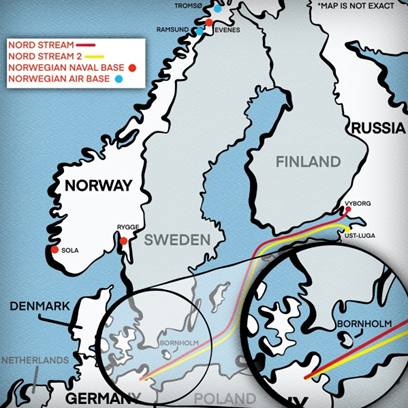
“On September 26, 2022, a Norwegian Navy Long Range Maritime Patrol (LRMP) aircraft on routine surveillance mission laid a sonobuoy field south of the Danish Island of Bornholm to seemingly surveil the underwater space in the region of the Nord Stream 1 and 2 gas pipelines emanating from the Russian pumping stations of Vyborg and Ust Luga, terminating at the Lubmin station in Germany. The conduits span a distance of about 1200 kilometres, most of the transit runs below the Baltic sea through the Gulf of Finland travelling East-West to south of Bornholm before making landfall on the German coast near Greifswald (see Map).  A few hours into the patrol, high-powered explosions were sensed in the vicinity of the pipelines and “within a few minutes, slicks of methane gas could be seen spreading on the water’s surface”. It was later established that three of four Nord Stream pipelines were blasted out of commission. So far investigations by Swedish, Danish and German authorities have not pinned the blame on any one country or actor.

Gas supply to Europe, during the on-going conflict in Ukraine, is a very profitable source of revenue to a ‘severely’ sanctioned Kremlin. It not only fuels the war effort but also rejects the Western forecast of a critical contraction of the Russian economy by as much as over 12%, in reality the contraction is closer to 2%.

The Seymour Hersh Report

Enter Pulitzer Prize-winning journalist Seymour Hersh; of My-Lai, Abu-Ghraib and Turkey’s use of chemical weapons in Syria, fame. He has in a self-published report on 08 February 2023 titled “How America took out the Nord Stream pipeline”, made a disquieting claim that “the pipeline blow-out was the handiwork of the American intelligence agency, CIA”. According to him, US Navy divers had been ordered to plant the explosives in a covert operation in June 2022, under cover of a NATO exercise BALTOPS 22. Hersh has suggested the explosives were triggered by sonobuoys laid for the purpose on 26 September 2022. Motive behind the American action was the need to reduce the commercial gains of Russia amidst its war with Ukraine. It was also an attempt to reduce the dependence of Europe on cheap Russian gas.

The facts that Hersh has used to substantiate his case are centred on a statement made by the US President Biden on 07 February 2022, when in the Q &A session, he declared that “if Russia invades Ukraine there will no longer be a Nord Stream 2”. This proclamation was made in the presence of German Chancellor Sholtz with an assertion that this would be the result of “joint action”. The second fact relates to a NATO maritime exercise conducted between 05-17 June 2022 in the South West Baltic Sea, codenamed “BALTOPS” in which 14 NATO nations along with two partners participated. And here, Hersh relies on an undisclosed source for the conjecture that the sub-surface explosives were laid under cover of this exercise, and were set off by a cooperating LRMP. The third and last fact was that on 26 September 2022, the Nord Stream 1 and 2 pipelines were struck by underwater explosions that busted three of four pipelines running south of the Danish Island of Bornholm.

Who Struck the Pipeline? And Why?

But the unanswered questions remain: Who sabotaged the Nord Stream pipe line? And how plausible is the Hersh Report? It makes little sense that Russia would punish itself by cutting off a vital source of funding to its military operations, particularly so when faced with economic contraction. At the same time to permanently throttle gas supply and reduce the EU’s dependence on Russia could only serve to stiffen NATO’s resolve to back Ukraine in its war-effort. After all, Russia could just as well have shut the tap if it was control that it wanted to establish. Clearly, the part played by America in terminally ending gas supply is more convincing. Intention being to cement and unify NATO’s resolve to exploit Ukraine’s case in the conflict. In support of this argument is a statement made by US Secretary of State Antony Blinken in September 2022, when he called Europe’s end of dependence on Russian energy supply as a “tremendous opportunity” to undercut Vladimir Putin’s power and influence in the region.

Map: Nord Stream 1 & 2 Source: https://pedlowski.files.wordpress.com/2023/02/hearsh-how-america-took-out-the-nord-stream-pipeline.pdf

Continuance of the conflict with NATO support selectively restricted to “just enough” surveillance, intelligence and supply of land based short range arms and munitions of low conventional yield and defensive in nature would appear to be the order of things. US expenditure on the conflict makes apparent that it has morphed to a proxy-war between America and Russia with the aim of bleeding the latter to a state of emasculation.

The Proxy War: To Emasculate Russia

Proxy wars involve the sponsorship of actors by an external state to influence a violent conflict’s outcome for the external state’s own strategic purposes. This characterization encompasses two considerations; firstly, the needs of the sponsoring state to avoid direct engagement while supporting the client state on the ground in order to obtain strategic political goals and secondly to prevent escalation beyond certain limits. It is there for all to discern why providing air-power to Ukraine is a no-no while the prospects of direct violence afflicting the US is kept at bay.

In any proxy-war, great-power competition does not visibly show itself by direct and high-intensity wars. The US has extensive background with indirect strategies and vast political experience with sponsoring separatists and regular forces in campaigns. One need only look at the US involvement early in the Vietnam War, in Congo, Afghanistan (1979-89), Libya, military operations in Syria, involvement in Yemen and Iran for confirmation of its reliance on the indirect approach. The US understands full well that the key to enfeeblement is protraction of conflict.

Conclusion

The Nord Stream episode may or may not have been engineered, yet it has brought about a situation that has energised a proxy war on Russia without direct involvement of America or the NATO in military operations. The larger aims of enervating Kremlin’s power and influence globally seem to be well underway. Nevertheless, the global economic fallout and its debilitating effects on the growth and privations of the European people puts a question mark on how long this proxy war can be sustained. But central to US strategic aims is the ability of Ukraine to bear with the daily crippling hardships of a devastating war and their nation being reduced to a grisly battleground.   

China: Foreign Policy, Disinformation and Propaganda Warfare

By

Vice Admiral (Retd) Vijay Shankar

Published in Salute Magazine available at https://salute.co.in/chinas-foreign-policy-disinformation-and-propoganda/

The United Front Work Department … is an important magic weapon for strengthening the party’s ruling position … and an important magic weapon for realising the China Dream of the Great Rejuvenation of the Chinese Nation.

                                      —Xi Jinping, at the 2015 Central United Front Work Meeting

To Influence the Balance of Power

In 2015 when Xi Jinping made the above declaration it was bemusing as to what exactly the United Front Work Department (UFWD) was and how exactly it would serve to realise China’s dream of the “Great Rejuvenation”. Was it an internal tool of governance or did its mandate extend outside its borders? In its central role the “UFWD was the key to determine the ‘cause’ of the Chinese Communist Party (CCP) for which the People were to influence the Balance of Power.” This muddled statement serves more to confuse than clarify; unless, one were to interpret this to mean that the UFWD was an organisation that not only served to ensure the solidarity of the citizens of China with the aims of the CCP but also had an external role that tilted the global balance of power in favour of the PRC. So not only was it primacy of the UFWD in domestic politics but also its critical assignment in shaping foreign policy and influencing overseas Chinese affairs.

In this perspective the Ministry of Foreign Affairs (MFA) does not make or even implement foreign policy, other than of a proforma nature, but provides the logistical framework for operationalizing policies. So much so, that today the Foreign Minister is neither a member of the seven-man Politburo nor is he the top foreign policy maker. Premier Xi, created in 2018, the Central Foreign Affairs Commission placing it directly under the Standing Committee of the Politburo which he led. There is a third organ related to the advancement and rendering of foreign policy goals that bears mention, and that is the International Liaison Department (ILD) which is charged with developing policies that create support for Chinese foreign initiatives and supress opposition. It specifically targets influential personalities and even conducts discreet propaganda, preparation of pliant politicians, society elites, media members and influencers.

The Paramount Leader

The troika of the UFWD, the MFA and the ILD thus make up the foreign policy institutions of China. Together they serve to firstly, legitimise and cement the rule of the CCP within and secondly, to formulate, support and promote foreign policy initiatives without.  The instruments used range from armed subversion to disinformation campaigns.  

Xi Jinping is the General Secretary of the CCP, chairman of the Central Military Commission (CMC), leader of the Standing Committee of the Politburo and indeed the President of the PRC; he has assumed the mantle of Paramount leader and by 2022 had extended his rule by an unprecedented third term (Mao was the last Chairman to do so). He has thus consolidated his grip on all aspects of the Chinese power structure; particularly so it’s internal and external manifestation.

Quiet Diplomacy: Propaganda, Subversion and Information Warfare

              As mentioned earlier, China’s MFA conducts the pro-forma traditional state-to-state diplomacy and provides the logistical framework for enabling policies. The lesser-known more recent UFWD and the older ILD working under the direction of the Standing Committee of the Politburo, conduct “Quiet Diplomacy”. Historically, such diplomacy almost exclusively meant foreign communist parties, but today it includes parties of varying ideologies, the process of cultivating potential support and supressing opposition to Chinese interests. 

Both the UFWD and the ILD have expanded their activities to include financing, recruiting, indoctrinating and arming subversive groups that promote Chinese interests. To further the foreign policy goals, the two organs use their foreign contacts to build support and advance its projects and mobilise opinion in target countries. In the lead-up to the 100th anniversary of the CCP’s founding (2021), the Party published a lengthy article outlining the core missions of their foreign enterprises in the modern era. While the obligatory CCP slogans and bromides were employed, it centred on gathering intelligence, influencing and garnering opinion for its initiatives through “consultative mechanisms”. The only overt project referenced was (for obvious reasons), the Belt and Road Initiative (BRI). These ‘consultative mechanisms’ do not just include communist and socialist parties, but political elites, media celebrities and, without stating it, every group or agency that could directly or indirectly influence the desired outcome.

Enter the BBC Documentary

              A two part documentary on Prime Minister Narendra Modi was released by the BBC on 17 and 24 January 2023. The first part covers Modi’s early political career and the period when he was the Chief Minister of the state of Gujarat, specifically during the 2002 communal riots and the part he played in the event as it unfolded. This is also when the producer parts way from the facts; conveniently forgetting the reality that the Supreme Court of India upheld the Special Investigation Team’s (SIT) clean chit to PM Narendra Modi and dismissed the case observing that the plea was devoid of merit. This was after a period of 16 years. The Producer, a Mr Mike Bradford and Director Dick Cookson choose rather to base their narrative on a little known report authored by the then Foreign Secretary of the UK, Jack Straw (of “WMDs in Iraq” fame). The makers of the film neither consider it necessary to make clear as to who invited Jack to conduct his enquiry nor why or when. Certainly it was not the Government of India.The second part of the film deals with the period of Mr Modi’s re-election for a second term as India’s Prime Minister. It makes a very jaundiced examination of select policies of his administration with more than just a cavalier approach to the historical reasons, constitutional considerations and the factual outcomes.

              Clearly the two-part so called documentary (after all, a documentary is expected to document facts) lost its way somewhere between fact, selective amnesia and fiction; so questions that beg to be asked are: why was it made? Who was to benefit? Clearly, it was not the British Government, Prime Minister Mr Rishi Sunak, without any reservation “disagreed with the characterisation” of Mr Modi in the ‘documentary’. Countries such as the USA denied having anything to do with it while Russia quite bluntly suggested that it was pure “propaganda’.

The Propaganda Theory

Digging deeper into the propaganda theory, was there a larger movement to peddle influence and to what effect and by who? The Institute of Chartered Accountants England and Wales (ICAEW) pointed out in 2021: “The BBC faces significant financial challenges as it seeks to deliver on its public broadcasting mission in the context of a competitive and fast changing environment. The withdrawal of government funding for licence fees for the over-75s and insufficient commercial income have resulted in losses that have eaten into the BBC’s reserves”. This fact has also been substantiated by a National Audit Office Report of 25 January 2021 that suggests that BBC must develop a strategic response to its financial challenges. The BBC has funded the losses arising in recent years from a combination of its reserves and a sale and leaseback of its estate, but this is not sustainable in the long run. To supplement the licence fee the BBC seeks to generate revenues through commercial activities, which generated £1.5bn in external revenue in 2019-20. Unfortunately, the contribution to the bottom line was less than 6% of its licence fee income. Licence Fee in their 2019-20 balance sheet contributed 65% of their total income of £4.9 billion.  Income was £100 million short of expenditure. The BBC’ financial woes are clear for all to see.

There are also unconfirmed reports of the BBC’s financial interlocking with Chinese state funding agencies. Could these funding agencies be the very same organs of China’s foreign policy, the UFWD or the ILD that are tasked with “Quiet Diplomacy”? It is equally apparent that China would be the chief beneficiary of any disruption or upsets that may occur in the upcoming 2024 Indian general elections; their motive being the installation of a weak, left leaning and pliable government in the Indian Parliament rather than a strong, progressive right wing party such as the BJP. This is not beyond the realm of probabilities as the Chinese Communist Party have already been allegedly involved in election tampering in the USA and other nations.

Conclusion: Kindling the Nascent Arena for Defence

Sun Tzu in his treatise on “The Art of War” suggested that: “the supreme art of war is to subdue the enemy without fighting”. This is just what the waging of “Quiet Diplomacy” (at least the Chinese variant) is all about. The United Front Work Department and the International Liaison Department provide the teeth to realise China’s foreign policy objectives, to influence the will of people to conform to China’s point of view. This is done through the instrument of distortion of facts, disinformation, indoctrination and indeed manipulating and falsification.

While the government should continue to monitor and disrupt Chinese influence activities, its top priority must be restoring health of the Indian information ecosystem. Disinformation flourishes due to deep-seated currents in politics, society, economy, and law. Its carriers and methods include the TV, online data collection, social media micro-targeting, political party dynamics and student vulnerabilities. Large-scale progress in combating disinformation would require profound national reforms in these and other arenas. The aim being to disincentivize the production, amplification, and consumption of disinformation from all sources.

True reform would be an extremely daunting task. The government’s role in combating disinformation is poorly defined and heavily constrained by laws, norms, and political obstacles. Its tools are often tactical in nature and oriented toward foreign threats. Overreach by the centre could actually worsen political distrust or create harmful precedents.

The task of countering disinformation is a nascent area of defence that the government could either implement or help to coordinate. These measures include strengthening regulation of online platforms, reforming and monitoring electoral campaign finance and advertising. Funding media literacy education and facilitating research in influence operations. Without undertaking this mammoth assignment the spirit of India will remain susceptible to the emaciating effects of disinformation.